Soft Lighting for Flats
Soft Lighting for Flats is a lighting plan for readers weighing lamp placement, warm bulbs, renter limits, and evening atmosphere. The home detail note explains what to check before buying, who should skip it, and where the purchase can become more work than it first appears.
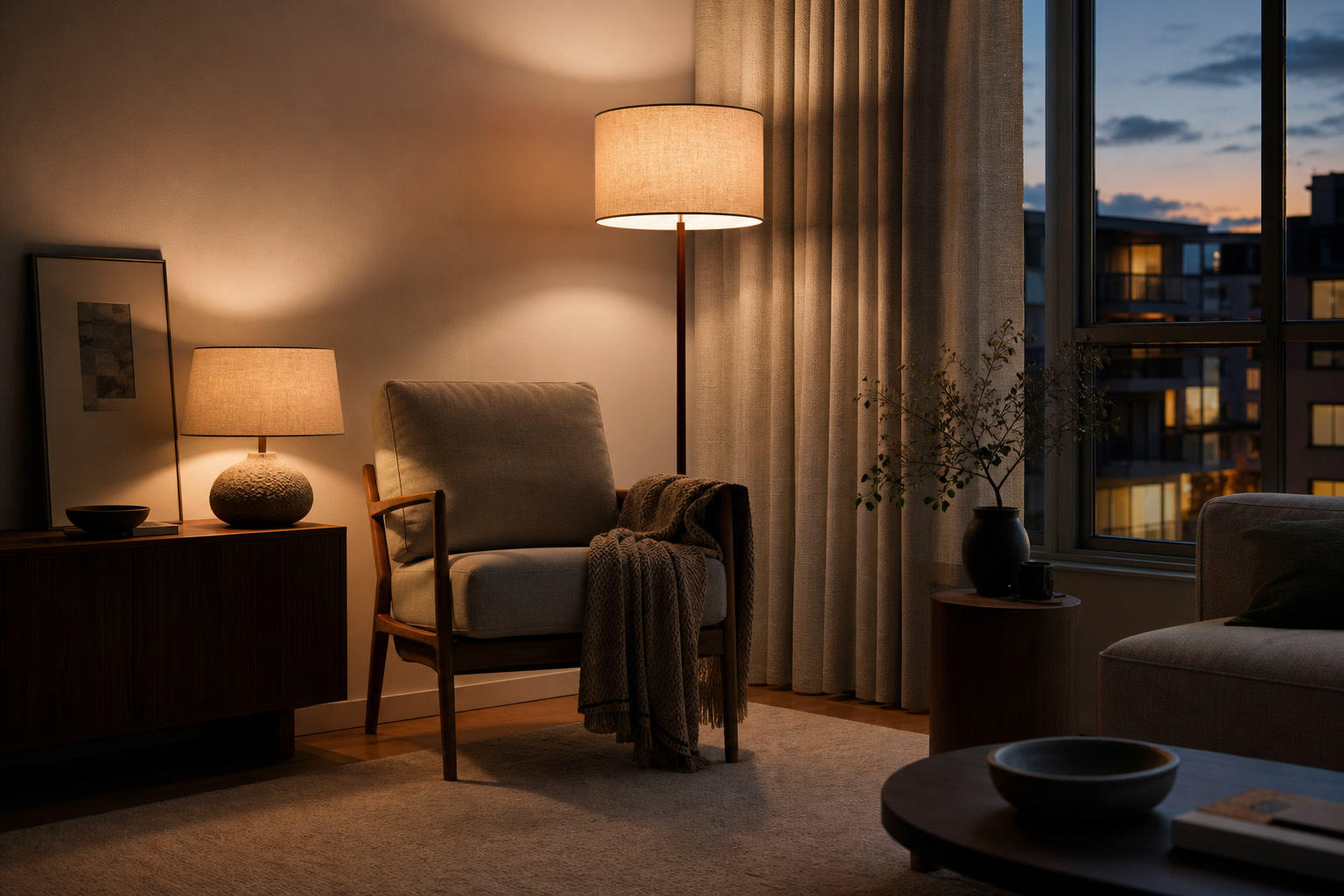
The transition from the demands of the day to the quiet of the evening is rarely achieved by simply walking through the front door; it requires a deliberate shift in the physical environment. In an apartment, where spatial boundaries between the home office, the dining area, and the living room are often blurred or nonexistent, lighting becomes the primary architectural tool for establishing domestic boundaries. Relying on overhead ceiling fixtures-often installed by landlords with a preference for harsh, flat, high-lumen output-erases the natural shadows that give a room depth and texture. Cultivating a soft lighting scheme through a deliberate arrangement of floor and table lamps is not merely an aesthetic exercise, but a functional routine that signals the nervous system to downregulate. By layering mid-level and low-level light sources, you create distinct zones of warmth that draw the eye downward, shrinking the perceived scale of the room to a more intimate, human proportion. This approach demands a careful evaluation of materials, from the tactile resistance of a brass rotary switch to the specific diffusion properties of linen versus opal glass, ensuring that the fixtures themselves look as intentional in the cold light of morning as they do when illuminated at night.
The Architecture of Evening: Dismantling the Overhead Glare
The fundamental flaw of standard apartment lighting lies in its origin: overhead flush mounts and recessed cans are designed to flood a space with uniform, shadowless illumination, a utility better suited to a commercial kitchen than a living space. When a single overhead source dominates a room, it flattens the visual landscape, exposing every corner with an aggressive clarity that actively works against relaxation. The evening routine should begin with the physical act of turning off this primary switch. Replacing that single, glaring source with three or four distinct points of lower-intensity light fundamentally alters the geometry of the room. It creates pools of illumination separated by gentle shadows, establishing a visual rhythm that guides the eye and defines specific areas of use-a reading chair, a dining alcove, a record console-without the need for physical walls.
This layered approach relies on understanding the distinct roles of ambient, task, and accent lighting within a confined footprint. Ambient light from a paper floor lamp might provide the base layer of soft, diffused brightness, while a directed metal table lamp offers the focused task lighting necessary for reading. The goal is to eliminate the visual friction caused by stark contrasts between pitch-black corners and blinding bulbs. Instead, the light should wash over the walls and pool on surfaces, highlighting the texture of the plaster, the grain of the wood, and the weave of the upholstery. This transition requires a conscious effort to map out the sightlines of your apartment from a seated position, ensuring that bare bulbs are never directly in the line of sight when you are resting on the sofa or lying in bed.
Establishing this routine also forces a confrontation with the limitations of your apartment's electrical layout. Older buildings rarely have outlets exactly where you need them, leading to the inevitable challenge of cord management. Rather than viewing cords as a nuisance, consider them a structural reality of the soft lighting scheme. Planning the placement of your lamps involves mapping the routes along baseboards and behind furniture to conceal the wiring, or deliberately choosing fixtures with heavy, fabric-wrapped cords that can be left exposed without looking like temporary dorm-room solutions. The physical act of moving through the apartment, turning on each lamp individually, becomes a grounding ritual that formally closes the working hours.
Floor Lamps as Structural Anchors and Spatial Dividers
In the hierarchy of apartment lighting, the floor lamp serves as the structural anchor, often compensating for the lack of architectural features in a standard white-box rental. Because they occupy vertical space without requiring a surface to sit on, floor lamps are uniquely positioned to draw the eye upward and establish the height of a room. However, their physical footprint must be carefully scrutinized. A heavy, solid base-typically cast iron, solid brass, or marble-is non-negotiable. Lightweight bases, often found in cheaper alternatives, result in a precarious lean on carpeted floors and a constant tipping hazard in high-traffic areas. The stem of the lamp should exhibit absolute rigidity; any wobble at the joints indicates poor threading and a compromised lifespan. When evaluating a floor lamp, the tactile experience of the materials matters immensely: cold-rolled steel, unlacquered brass that will develop a patina over time, or solid walnut offer a permanence that painted aluminum simply cannot replicate.
The choice of shade dictates the behavior of the light and the maintenance burden of the fixture. Noguchi-style rice paper shades have seen a massive resurgence due to their unparalleled ability to diffuse light into a warm, omnidirectional glow that softens the harshest of LED bulbs. Yet, paper is inherently fragile. It requires careful placement away from open windows where sudden gusts can cause tears, and it is highly susceptible to yellowing from UV exposure or collecting airborne cooking oils in open-plan apartments. Dusting a delicate paper shade requires a soft, dry microfiber cloth and a very light touch. Conversely, a spun-metal shade forces light into a strict, directional cone, creating dramatic pools of light on the floor but contributing very little to the overall ambient brightness of the room. Metal shades are utilitarian and easily wiped clean, but they demand precise placement to avoid creating harsh, unyielding shadows.
For those dealing with extreme space constraints, the tension-pole floor lamp offers a compelling alternative. Wedged between the floor and the ceiling, these fixtures require zero floor space for a bulky base and often feature multiple adjustable heads, allowing you to bounce light off the ceiling for ambient fill while directing another beam downward for reading. However, their installation requires a solid, flat ceiling-popcorn ceilings or drop tiles will not support the tension. Regardless of the style, a floor lamp represents a significant visual commitment. When unlit during the day, it functions as a piece of sculpture. If the materials look cheap or the proportions feel awkward in the natural light, the lamp will remain a visual irritant, no matter how pleasant its glow is at night.
Table Lamps: Scale, Materiality, and the Mid-Level Glow
Table lamps are the workhorses of the soft lighting scheme, responsible for bridging the gap between the low pools of light from floor lamps and the ceiling. Their placement on credenzas, side tables, and bookshelves introduces illumination at eye level, which is crucial for flattering the human face and creating a sense of intimacy. The primary challenge with table lamps is scale. A lamp that looks perfectly proportioned in a cavernous showroom will often overwhelm a narrow apartment nightstand, leaving no room for a book, a glass of water, or an alarm clock. Before purchasing, it is essential to cut a piece of cardboard to the exact diameter of the lamp's base and place it on the intended surface to gauge the actual footprint. Furthermore, the height of the shade must be calculated relative to your seated position; the bottom rim of the shade should ideally sit right at or slightly below eye level to shield the retina from the glare of the bare bulb.
The materiality of the table lamp base heavily influences both its aesthetic weight and its maintenance requirements. Ceramic and stoneware bases introduce an organic, earthy texture that grounds a room, but their porous nature can attract dust that settles deep into the glaze's crazing. Solid glass bases, whether blown or cast, offer a lighter visual footprint, making them ideal for small spaces where you want to maintain sightlines through the object. However, clear glass requires meticulous, streak-free cleaning and fully exposes the central hardware and wiring, demanding that the internal components be as beautifully finished as the exterior. Pleated linen or silk shades, while classic and excellent at diffusing light, act as magnets for pet hair and dust. Cleaning a pleated shade requires a specialized soft brush attachment on a vacuum, used on the lowest suction setting, to avoid warping the fabric or crushing the pleats.
The rise of portable, rechargeable LED table lamps has introduced a new layer of flexibility to apartment lighting. These small, cord-free fixtures can be moved from the dining table to the balcony to the bathroom counter, providing transient pockets of light exactly where needed. While highly convenient, they should be viewed as supplementary rather than foundational. The battery life degrades over years of continuous charging cycles, and because the LED modules are almost always integrated, the entire lamp becomes electronic waste once the battery or the diode fails. For permanent, long-term fixtures, traditional wired table lamps with standard, replaceable sockets remain the far superior choice for longevity and repairability.
The Mechanics of Warmth: Bulbs, Dimmers, and Cord Management
The most exquisite lamp in the world is rendered useless if fitted with the wrong bulb. The entire premise of evening soft lighting hinges on color temperature, measured in Kelvins (K). For a residential space after sunset, 2700K is the absolute maximum threshold; it provides a warm, traditional incandescent-like glow suitable for reading and general living. For late evening, transitioning to 2200K or 2400K introduces an amber, fire-like quality that actively promotes relaxation. Anything above 3000K belongs in a hospital, a garage, or a high-focus office environment, as the blue light spectrum inhibits melatonin production and creates a sterile, clinical atmosphere. Equally important is the Color Rendering Index (CRI). A bulb with a CRI of 90 or above ensures that the colors of your furniture, art, and skin look natural and vibrant, whereas cheap LEDs with low CRI values will cast a sickly, greenish-gray pallor over the room, regardless of how warm the Kelvin rating is.
Dimmers are essential for controlling the volume of light, allowing a single fixture to transition from a functional reading lamp at 7 PM to a dim, glowing ember at 11 PM. However, the interaction between modern LED bulbs and traditional dimmer switches is notoriously fraught. In-line cord dimmers or wall switches designed for old incandescent bulbs will often cause LEDs to flicker, buzz audibly, or drop out completely at the lower end of the dimming range. It is crucial to ensure that both the bulb is explicitly labeled as 'dimmable' and that the dimmer switch uses trailing-edge technology designed specifically for LED loads. If a lamp comes with an integrated dimmer, test its lowest setting immediately upon arrival; a dimmer that only reduces the light output by half before shutting off defeats the purpose of the feature.
Cord management is the unglamorous reality of a layered lighting scheme. A beautiful brass floor lamp loses its elegance if it is trailed by a stiff, kinked, black plastic cord snaking across a hardwood floor. Look for fixtures that utilize fabric-wrapped cords, which drape naturally, resist kinking, and look intentional even when exposed. For cords that must traverse open spaces, heavy-duty cord covers that match the floor color are a necessary, if utilitarian, compromise. When storing seasonal lamps or moving, cords should never be wrapped tightly around the base or the stem, as this stresses the internal copper wiring and leads to eventual shorts. Instead, loop the cord loosely in a figure-eight pattern and secure it with a soft tie to preserve the integrity of the connection.
Shipping, Assembly, and the Reality of Fragile Freight
Purchasing substantial lighting fixtures online introduces a significant logistical burden and a high risk of transit damage. Large floor lamps and fragile ceramic or glass table lamps are notoriously difficult to ship. They arrive encased in massive quantities of molded styrofoam-a material that inevitably disintegrates upon opening, coating the apartment in static-charged white beads that take weeks to fully eradicate. The returns process for a damaged lamp is often a nightmare of trying to force a shattered ceramic base and a bent metal shade back into a compromised box. It is highly recommended to carefully slice the tape and preserve the original packaging in its exact configuration for at least a week. If the lamp arrives with a dented shade, a scratched base, or a faulty socket, having the intact packaging is the only way to facilitate a return without incurring exorbitant repackaging fees.
Assembly is another critical juncture where the quality of the fixture is revealed. Many floor lamps ship in segmented poles that must be screwed together. During this process, the internal electrical cord must be carefully pulled through the base to prevent the wires from twisting and snapping as the pole sections are rotated. Cheaply machined threads will bind, cross-thread, or leave visible gaps between the segments, ruining the clean look of the stem. If a lamp requires significant force to assemble, stop immediately; forcing the threads will permanently damage the fixture. Additionally, inspect the point where the cord exits the base. There should be a rubber or plastic grommet protecting the cord from the sharp metal edge of the exit hole. A missing grommet is a severe safety hazard, as the metal will eventually slice through the cord's insulation over years of minute movements.
Finally, the long-term viability of the lamp rests entirely on its socket design. The current trend of fixtures with integrated, non-replaceable LED arrays should be approached with extreme caution for primary lighting. While they allow for incredibly thin, futuristic designs, an integrated LED has a finite lifespan. When the driver fails or the diodes burn out-often far sooner than the advertised 50,000 hours due to heat buildup-the entire lamp becomes unrepairable garbage. Investing in fixtures that utilize standard E26 or E27 screw-in sockets ensures that the lamp can outlive the current bulb technology. A well-made brass and glass lamp with a standard socket is a generational object; an integrated LED lamp is, ultimately, a disposable appliance.
Pre-purchase checklist
- Verify the socket type: Prioritize standard E26/E27 sockets over integrated LEDs to ensure the lamp can be repaired and used for decades.
- Measure the base footprint: Cut a physical cardboard template of the lamp's base diameter to confirm it fits on your specific side table or floor space without crowding.
- Check the bulb specifications: Ensure any included or purchased bulbs are 2700K or warmer (2200K-2400K) with a CRI of 90+ for optimal evening ambiance.
- Inspect the cord material and length: Confirm the cord is long enough to reach your outlets without extension cords, and prioritize fabric-wrapped cords for better draping and aesthetics.
- Examine the cord exit point: Ensure there is a protective rubber or plastic grommet where the electrical cord exits the metal base to prevent the insulation from fraying over time.
Who should skip this
Individuals who require high-intensity, high-CRI lighting for detailed evening task work-such as drafting, sewing, or intricate crafting-should not rely solely on a soft, ambient lighting scheme, as the diffused, warm light will cause severe eye strain during precision tasks. Additionally, those living in extremely tight quarters with highly active large pets or toddlers should avoid lightweight or tripod-style floor lamps, as well as delicate paper shades, due to the high risk of tipping, tearing, and the resulting safety hazards. In these specific environments, heavy-duty wall sconces or securely mounted plug-in pendants offer a safer alternative to freestanding fixtures.
Affiliate transparency
FikaLooks maintains strict editorial independence. We evaluate home fixtures based on material integrity, repairability, and long-term utility. If you purchase a lamp or lighting accessory through the links in this article, we may earn a commission, which funds our continued research into sustainable and enduring home goods.
FAQ
Can I mix different metal finishes across my floor and table lamps?
Yes, mixing metals adds depth and prevents the room from looking like a purchased set. The key is to establish a dominant metal (e.g., blackened steel or matte black) for the structural floor lamps, and use a secondary metal (e.g., unlacquered brass or polished nickel) as an accent for table lamps or smaller fixtures. Keep the finishes to a maximum of two or three to maintain cohesiveness.
How do I clean a delicate rice paper or Noguchi-style lamp shade?
Never use water or liquid cleaners, as they will dissolve the paper and leave permanent watermarks. Use a clean, dry microfiber cloth or a soft-bristled drafting brush to gently sweep dust off the surface. For deeper cleaning, use a vacuum with a soft brush attachment on the absolute lowest suction setting, holding the paper taut with your free hand to prevent tearing.
Why does my new LED bulb buzz when I use the lamp's dimmer switch?
Buzzing is caused by a mismatch between the LED bulb's internal driver and the dimmer switch's technology. Older dimmers (leading-edge) were designed for the high wattage of incandescent bulbs and chop the electrical current in a way that causes LEDs to vibrate and buzz. You must use a bulb specifically rated as 'dimmable' and ideally pair it with a modern, trailing-edge LED dimmer.
Are smart bulbs worth using in a soft lighting scheme?
Smart bulbs offer excellent flexibility, allowing you to program routines that automatically lower the brightness and shift the color temperature warmer as the evening progresses. However, they require the lamp's physical switch to remain constantly 'on,' which breaks the tactile routine of manually turning on a lamp. They are best used in hard-to-reach floor lamps rather than bedside table lamps where manual control is preferred.