Hair Dryer Buying Guide
Hair Dryer Buying Guide is a buying guide for readers weighing heat control, drying speed, attachments, noise, and storage. The beauty routine note explains what to check before buying, who should skip it, and where the purchase can become more work than it first appears.
A hair dryer is the foundational tool of any styling routine, yet it is often the most misunderstood piece of hardware on the vanity. For decades, the standard approach to drying hair relied on a crude combination of extreme heat and blunt force airflow, a method that routinely boiled the moisture out of the hair shaft and degraded the cuticle over time. Modern styling requires a shift in perspective, viewing the hair dryer not as a basic heater, but as an engineered instrument designed to manipulate water molecules, seal the cuticle, and establish the structural integrity of a blowout. Selecting the right model demands an understanding of motor mechanics, thermal regulation, and acoustic design. The difference between a mediocre dryer and an exceptional one is measured in the reduction of arm fatigue, the preservation of hair elasticity, and the quiet efficiency of the morning routine. This guide examines the internal architecture and material science of contemporary hair dryers, stripping away marketing hyperbole to focus on how airflow velocity, ionic output, and ergonomic balance dictate the final result.
Motor Architecture and Ergonomic Balance
The core engine of any hair dryer dictates its lifespan, weight, and acoustic profile. Traditional models rely on Alternating Current (AC) or Direct Current (DC) motors. AC motors are durable and powerful, often found in salon environments, but they are notoriously heavy, pulling the center of gravity forward and causing significant wrist strain during a prolonged blowout. DC motors offer a lightweight alternative for domestic models, yet they frequently lack the torque required for high-velocity airflow and possess a shorter operational life. The contemporary standard for high-end styling relies on brushless digital motors, which utilize neodymium magnets rather than carbon brushes. This eliminates internal friction, drastically reducing the weight of the tool while extending its lifespan into the thousands of hours.
Motor placement fundamentally alters the physical experience of drying hair. Historically, motors were housed in the head of the dryer, creating a top-heavy T-shape that required the user to constantly fight gravity. Modern engineering has allowed manufacturers to shrink brushless motors to the size of a coin, relocating them to the handle. This shift in the center of gravity transforms the ergonomics of the tool, balancing the weight directly in the palm rather than extending it outward. For individuals with thick, coarse hair that requires twenty minutes or more of continuous styling, this redistribution of weight is the difference between a comfortable routine and chronic shoulder fatigue.
Acoustic engineering is an equally critical, though frequently overlooked, component of motor design. The decibel level and pitch of a hair dryer impact the daily user experience, particularly in shared living spaces. Inferior motors produce a high-frequency whine, a byproduct of inefficient fan blades cutting through the air and vibrating against cheap plastic housing. Premium models manipulate the acoustic frequency, increasing the number of motor impeller blades to push the sound frequency beyond the audible range of human hearing. The result is a low, muffled hum rather than a piercing shriek, allowing for conversation or audio consumption while styling.
Thermal Regulation and Heat Damage Prevention
Raw heat is the enemy of hair health. Traditional dryers operate on a rudimentary binary system, pushing air over red-hot nichrome coils until the machine is switched off. As the rear filter accumulates dust, airflow decreases, causing the internal temperature to spike dangerously, often exceeding 250 degrees Fahrenheit. This extreme heat boils the water trapped inside the hair cortex, causing the shaft to blister and fracture. Advanced hair dryers move away from this crude heating method with intelligent thermal control. These systems utilize glass bead thermistors to measure the exit airflow temperature dozens of times per second, transmitting data to a microprocessor that regulates the heating element. This ensures the air never exceeds a safe threshold, preserving the structural proteins of the hair.
The material composition of the heating element further refines how temperature is applied to the hair. Ceramic and porcelain components are utilized to generate far-infrared heat, which penetrates the hair shaft to dry it from the inside out, rather than scorching the exterior cuticle. This results in a gentler, more even distribution of temperature, eliminating the hot spots that cause localized damage. Titanium hardware, conversely, conducts heat rapidly and intensely. While titanium can reduce drying time for thick, resilient hair types, it poses a significant risk of over-drying and snapping fine or chemically compromised hair if not carefully monitored.
Equally important to the heating element is the mechanism for cooling. A true cold shot is mandatory for setting a style, as the sudden drop in temperature rapidly seals the cuticle, locking in the shape created by the brush and enhancing the natural reflection of light. Inferior dryers merely turn off the heating element, requiring the user to wait while the residual heat dissipates from the coils. High-performance models bypass the primary heating chamber entirely when the cold button is engaged, delivering an immediate blast of ambient air. The responsiveness of this feature dictates how effectively a curl or volume at the root will hold throughout the day.
Decoding Ionic Technology and Airflow Velocity
The term 'ionic' is heavily utilized in styling marketing, but its mechanical function is highly specific. Wet hair is positively charged, causing the cuticle scales to lift and create a rough, frizzy texture. Hair dryers equipped with negative ion generators emit millions of negatively charged ions into the airflow. These ions attach to the positively charged water molecules on the hair, breaking them down into smaller micro-droplets that evaporate faster or are absorbed back into the hair shaft. This chemical reaction drastically reduces drying time while neutralizing static electricity, forcing the cuticle to lie flat and creating a sleek, polished finish.
However, negative ions are not universally beneficial. Because they excel at flattening the cuticle and eliminating friction, they also eliminate the natural grip required to build volume. Individuals with fine, limp hair often find that heavily ionic dryers leave their hair looking flat and lifeless, unable to hold a voluminous blowout. To address this, the most sophisticated dryers feature an ion switch, allowing the user to toggle the negative ion generator on or off. This provides the flexibility to build volume at the roots with positive, un-ionized air, before switching the generator on to smooth the mid-lengths and ends.
Airflow velocity is the metric that should replace wattage in the consumer's mind. Historically, buyers equated a 2000-watt dryer with superior performance, assuming higher power consumption meant faster drying. In reality, high wattage often masks inefficient fan design, utilizing massive amounts of electricity to generate heat rather than moving air. A well-engineered dryer prioritizes the Coanda effect and focused air pressure, utilizing a lower wattage to generate a high-velocity, concentrated stream of air. This mechanical force physically pushes water off the hair strand, drying the hair through kinetic energy rather than relying solely on thermal evaporation.
Attachment Architecture and Styling Precision
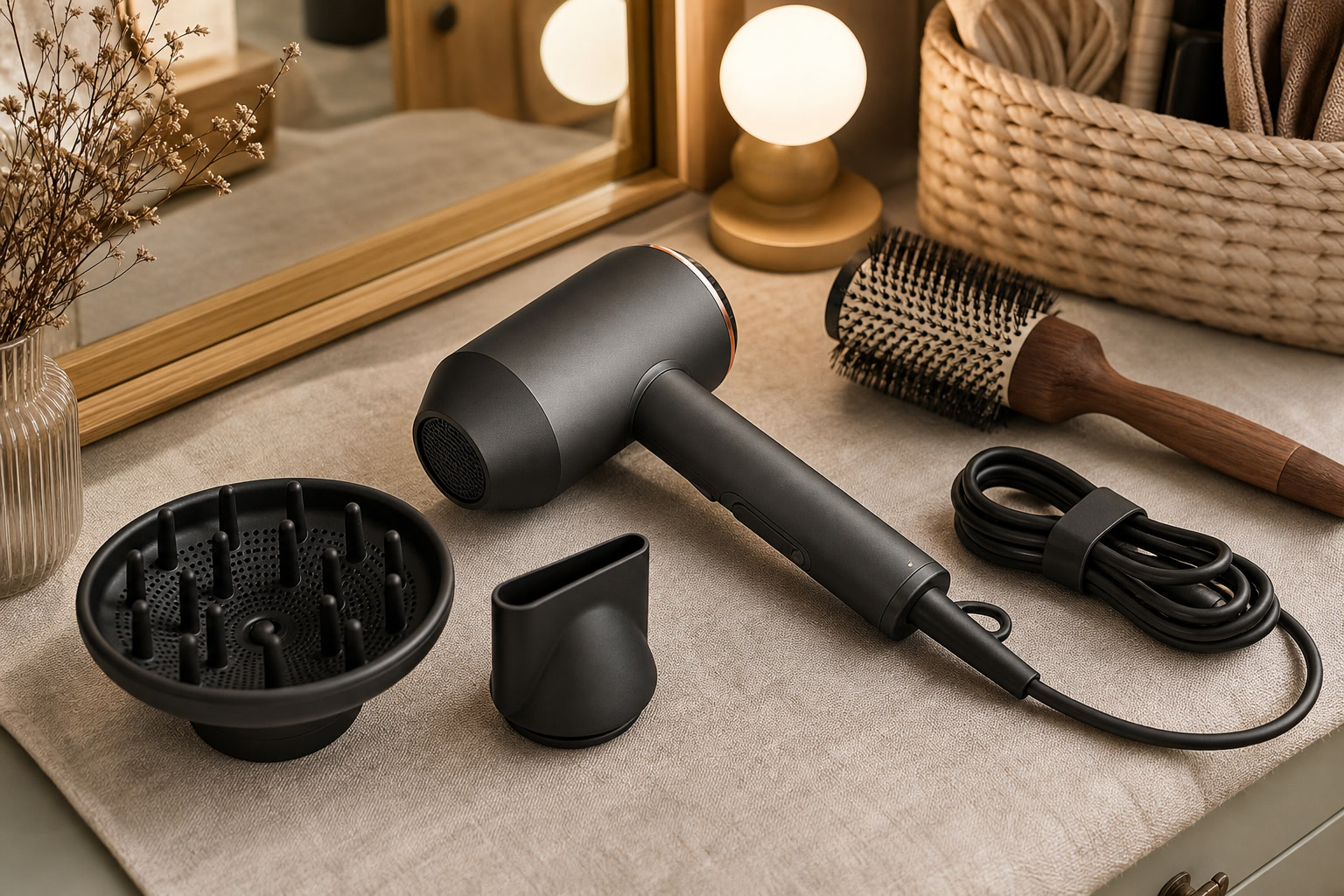
A hair dryer is only as effective as the attachments that direct its airflow. The concentrator nozzle is the primary tool for achieving a smooth blowout, designed to compress the air into a flat, blade-like stream. The width of this nozzle is critical: a wide concentrator is ideal for rough-drying and moving large sections of hair, while a razor-thin nozzle is required for precision work with a round brush, allowing the user to direct air exactly at the section under tension without disturbing the surrounding hair. Attachments that snap on with plastic clips inevitably degrade, warp from the heat, and fall off mid-styling. Magnetic attachments offer a superior, permanent solution, allowing for clean rotation and secure locking.
For textured, wavy, and curly hair, the diffuser is the most vital component. A poorly designed diffuser acts merely as a cage, blowing air aggressively and disrupting the natural curl pattern, resulting in a halo of frizz. An engineered diffuser features a deep bowl to cradle the curls without stretching them, and long, ventilated prongs that reach past the dense outer canopy of the hair to deliver air directly to the roots. The goal of a diffuser is to simulate the gentle evaporation of air-drying while accelerating the process, requiring an attachment that disperses the airflow so finely that it barely moves the hair strands.
Recent innovations have introduced specialized attachments designed to address specific styling challenges, such as flyaways and extreme texture. Flyaway attachments utilize aerodynamic principles to lift longer hairs to the surface while pushing shorter, broken hairs out of sight, replicating the smoothing technique previously only achievable by a stylist with a round brush. Wide-tooth comb attachments are engineered to stretch and lengthen tightly coiled hair as it dries, requiring robust materials that can withstand high tension without snapping. The material quality of these attachments is paramount; cheap plastics will conduct heat poorly, burning the scalp or melting under the thermal output of the dryer.
Maintenance Trade-offs and Hardware Longevity
The longevity of a high-performance hair dryer is directly tied to the diligence of its maintenance, specifically regarding the air filter. The motor requires a constant intake of ambient air to function and cool its internal components. When the rear filter becomes clogged with lint, dust, and aerosolized hair products, the motor suffocates. This forces the turbine to work harder, raising the internal temperature until the thermal fuse trips, shutting the machine down. Premium dryers feature magnetic, removable filter cages and micro-mesh screens that require weekly cleaning with a dedicated brush. Ignoring this maintenance is the primary cause of premature hardware failure.
Cord engineering is a subtle detail that significantly impacts both the usability and the lifespan of the tool. Standard domestic dryers often feature stiff, plastic-coated cords measuring six feet or less, restricting movement and forcing the user to contort near an outlet. Professional-grade styling requires a minimum of a nine-foot, heavy-duty rubberized cord. This material remains flexible over time and resists the internal wire fracturing that occurs from daily manipulation. Furthermore, the point where the cord meets the handle must feature a robust strain relief mechanism, preventing the wires from snapping when the dryer is angled during use.
Storage habits dictate the physical degradation of the dryer. The most common error is wrapping the cord tightly around the body or handle of the machine while it is still warm. This practice stretches the internal copper wiring, eventually causing a short circuit near the base of the handle. Proper storage requires looping the cord loosely beside the dryer or utilizing a dedicated storage stand. When evaluating the investment in a premium hair dryer, the calculation must account for this required care; a meticulously maintained, highly engineered tool will operate flawlessly for a decade, whereas a neglected, poorly constructed model will require annual replacement.
Pre-purchase checklist
- Verify the presence of a removable, washable micro-mesh filter to ensure the motor can be protected from dust and product buildup.
- Check the cord specifications for a minimum length of nine feet and a heavy-duty, flexible rubber casing rather than stiff plastic.
- Assess the weight distribution by holding the handle; the dryer should feel balanced in the palm without the nose dipping heavily forward.
- Confirm that the attachments utilize a magnetic or secure twist-and-lock mechanism to prevent them from detaching or warping under high heat.
- Test the cold shot button for latency; the airflow should drop to room temperature within three seconds of engagement to properly seal the cuticle.
Who should skip this
Skip a dedicated, high-performance hair dryer if you exclusively air-dry your hair, maintain a buzz cut, or rely entirely on hot air stylers and heated round brushes for your routine. For those who prefer an all-in-one tool that dries and styles simultaneously, a traditional standalone dryer will likely remain unused in a drawer, making the investment redundant.
Affiliate transparency
FikaLooks curates selections based on rigorous editorial standards and material analysis. If you purchase through our links, we may earn a commission, which supports our independent research and reporting.
FAQ
Does a higher wattage mean a faster blowout?
No. High wattage indicates how much electricity the heating element consumes, not the efficiency of the airflow. A well-engineered dryer with lower wattage but high-velocity, focused airflow will dry hair faster and with less thermal damage than a cheap 2000-watt model that simply bakes the hair.
Should I choose ceramic or titanium technology for fine hair?
Ceramic is the superior choice for fine or fragile hair. It produces a gentle, far-infrared heat that warms the hair evenly without creating hot spots. Titanium heats up aggressively and transfers heat rapidly, which is excellent for thick, coarse hair but poses a high risk of scorching fine strands.
Why does my hair dryer keep shutting off mid-use?
This is almost always caused by a clogged intake filter. When dust and lint block the airflow, the internal temperature of the dryer spikes. A built-in thermal safety switch automatically cuts the power to prevent the motor from melting or catching fire. Cleaning the filter usually resolves the issue.
Are magnetic attachments actually better than snap-on ones?
Yes. Snap-on attachments rely on plastic friction clips that expand, warp, and degrade after repeated exposure to high heat, eventually causing the nozzle to fall off during use. Magnetic attachments maintain their structural integrity indefinitely and allow for smooth, 360-degree rotation while styling.