Desk Lamp Style and Function
Desk Lamp Style and Function is a lighting note for readers weighing beam angle, glare, bulb warmth, adjustability, and desk footprint. The home detail note explains what to check before buying, who should skip it, and where the purchase can become more work than it first appears.
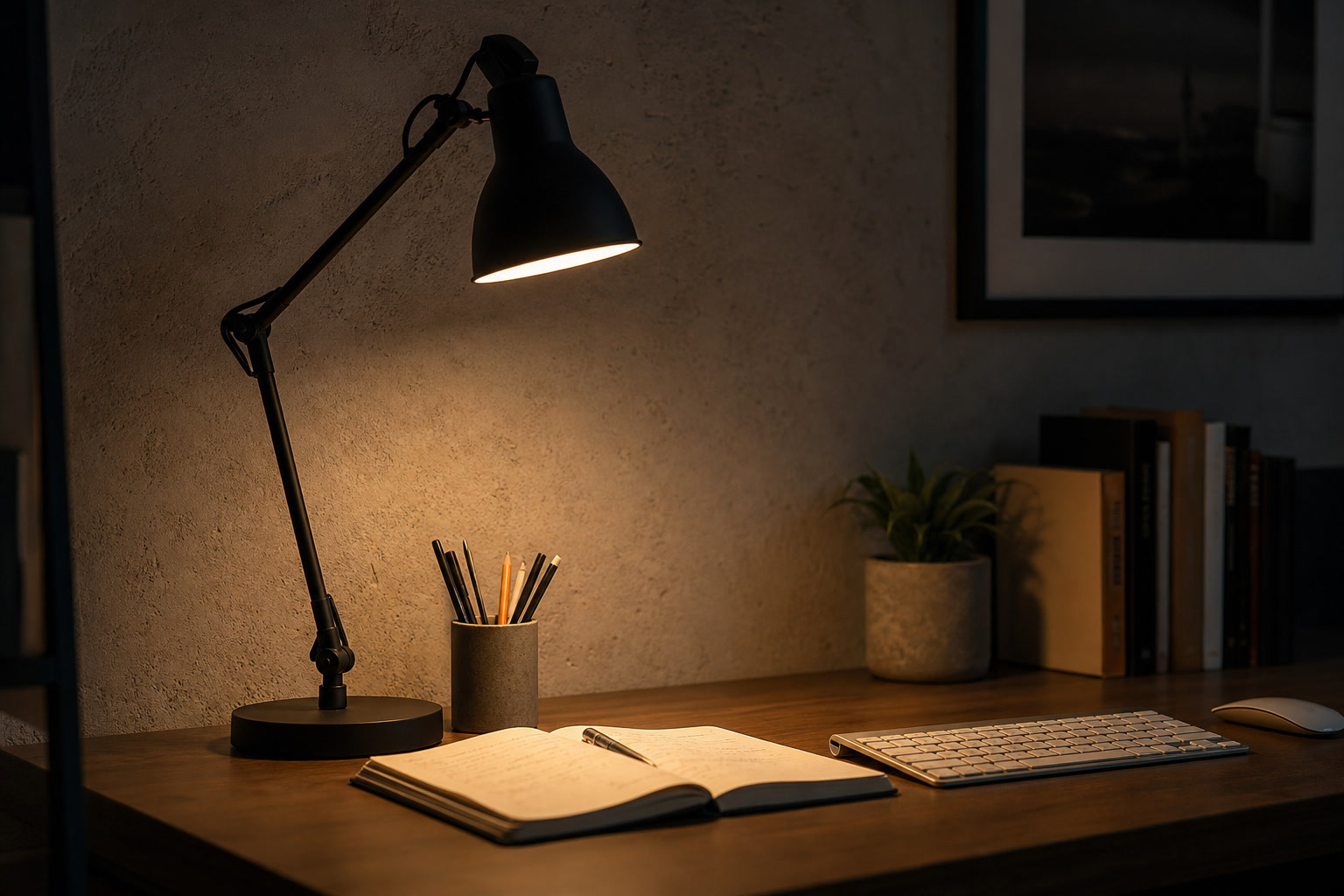
The desk lamp occupies a rare intersection of rigorous utility and sculptural permanence. As the anchor of the workspace, it dictates the atmosphere of your environment, drawing a physical boundary around your focus through a concentrated pool of light. A poorly engineered lamp introduces subtle, compounding frustrations: a drooping arm, a harsh glare reflecting off a monitor, or a base that tips under its own cantilevered weight. Conversely, a carefully selected fixture operates as a clean extension of your workflow, offering precise articulation and a color temperature that sustains concentration without fatiguing the eyes. Beyond its active duty, the desk lamp must hold its own as an aesthetic object. For the majority of the day, it sits unlit, demanding that its silhouette, materials, and mechanical joints possess enough visual integrity to complement the surrounding architecture. Selecting the right piece requires navigating the tension between industrial performance and domestic warmth, prioritizing tactile finishes, repairable components, and geometric proportions that respect the scale of your desk.
Architectural Scale and Spatial Geometry
The relationship between a lamp's structural architecture and the surface area of your desk dictates both its visual success and its functional viability. A sprawling, solid walnut drafting table without fuss absorbs the visual weight of a large, cantilevered crane lamp, utilizing the expansive reach to illuminate different quadrants of the workspace. Placing that same aggressive, long-armed fixture on a compact apartment writing bureau creates immediate spatial conflict, crowding out essential tools and looming disproportionately over the user. The footprint of the base must be measured against the depth of the desk, ensuring enough clearance remains for laptops, reference materials, and the natural resting position of your forearms.
Stability relies entirely on the physics of the base, a detail frequently compromised in lightweight, contemporary manufacturing. A lamp featuring a highly articulated arm requires a base of significant density-typically cast iron, solid brass, or weighted stone-to counteract the shifting center of gravity when the shade is pulled forward. The daily friction of adjusting a light source is entirely ruined if the user must employ a second hand to hold the base down to prevent tipping. For environments where surface area is severely restricted, clamp-mounted bases offer a rigorous alternative, anchoring the mechanics directly to the desk edge, though this requires a desk with a sufficient overhang and a material dense enough to withstand the localized pressure of the vice.
Visual weight is further determined by the opacity and shape of the shade, which governs how light interacts with the broader room. A heavy, spun-metal dome directs illumination strictly downward, creating a high-contrast environment where the desk is brilliantly lit while the periphery falls into shadow-a theatrical effect that sharpens focus but can cause eye strain due to the severe gradient. Alternatively, a shade crafted from translucent bone china, frosted glass, or perforated steel allows a percentage of the lumens to escape outward, diffusing a softer ambient glow that gently bridges the gap between the task surface and the surrounding architecture.
Material Integrity and the Aging Process
The materials chosen for a desk lamp dictate not only its immediate aesthetic impact but also its trajectory of aging and the maintenance it will demand. Unlacquered brass and copper represent living finishes, highly reactive to the oils in human skin and the ambient humidity of the room. Over years of daily adjustment, the areas most frequently touched-the rim of the shade, the stem, the switch-will develop a darkened, complex patina, mapping the history of its use. This requires a conscious acceptance of asymmetry; those who demand a permanently pristine, uniform golden hue must either commit to frequent, aggressive polishing or opt for a factory-sealed, lacquered alternative that halts the oxidation process entirely.
Powder-coated steel and matte aluminum offer a distinctly different tactile experience, trading the romanticism of patina for industrial durability and contemporary restraint. These finishes absorb ambient light, grounding the workspace with a quiet, non-reflective presence. However, the slightly porous texture of a matte finish acts as a magnet for atmospheric dust, requiring regular attention. Maintenance must be handled delicately; wiping a matte black or deep olive steel shade with abrasive cloths or harsh chemical solvents can inadvertently burnish the surface, creating permanent, shiny bald spots that ruin the intended light-absorbing effect. A dry microfiber cloth or a soft-bristled drafting brush remains the safest method for preserving the factory texture.
The physical interaction with the lamp culminates in the switch, a mechanical touchpoint that profoundly influences the perceived quality of the object. The satisfying, heavy mechanical clunk of a brass toggle switch or the smooth, hydraulic-like resistance of a knurled rotary dimmer provides immediate, reliable tactile feedback. In contrast, capacitive touch sensors-often embedded cleanly into the base or stem of modern fixtures-prioritize visual minimalism but frequently introduce operational friction. Touch sensors can be entirely unresponsive to cold fingertips or slight variations in pressure, turning the simple act of illuminating a room into a frustrating exercise in repetition.
Luminance, Acuity, and the Diode Dilemma
The scientific properties of the light emitted are just as critical as the housing that contains it, directly impacting visual acuity and circadian rhythm. The color temperature, measured in Kelvins, determines the psychological warmth or sterility of the workspace. A rating of 2700K to 3000K represents the ideal spectrum for a home office, offering a crisp, clear illumination that facilitates prolonged reading and screen work without tipping into the harsh, blue-tinted territory of 4000K, which mimics the clinical atmosphere of commercial fluorescents. Conversely, dropping below 2500K introduces an amber hue that, while deeply atmospheric, lacks the necessary contrast for deciphering fine print or maintaining alertness during evening hours.
For creatives, illustrators, architects, or anyone reviewing physical textiles and printed documents, the Color Rendering Index (CRI) is a non-negotiable metric. A high CRI, ideally 90 or above out of 100, ensures that the light source accurately reproduces the true colors of the objects it illuminates. Standard, lower-tier diodes often suffer from a poor CRI, casting a subtle green or gray pallor over the desk that flattens textures and washes out vibrant inks. Investing in high-CRI lighting removes this visual distortion, ensuring that the physical materials on your desk appear exactly as they would under natural, mid-day sunlight.
The modern lighting market is increasingly dominated by integrated LED panels, which allow designers to achieve astonishingly thin, blade-like silhouettes impossible to engineer around a traditional bulb. The inherent risk of this sleekness is the creation of future electronic waste. When an integrated diode eventually fails or begins to flicker, the entire fixture often becomes useless, requiring specialized repair or outright disposal. Opting for a lamp with a standard E26 or E27 threaded socket guarantees modularity and longevity. It allows the user to easily swap out bulbs, experiment with different wattages and color temperatures, and ensures that a beautifully crafted brass or steel housing can remain in use for decades, independent of shifting lighting technologies.
Mechanical Articulation and Glare Management
The defining characteristic of a true task lamp is its capacity for precise movement, relying on a system of mechanical joints to deliver light exactly where it is needed. Classic architectural lamps utilize exposed tension springs, counterweights, and friction hinges to achieve a state of suspended balance, allowing the user to reposition the shade with a single finger. The quality of these internal mechanics separates heirloom fixtures from disposable replicas. Inferior lamps rely on cheap plastic washers or weak internal springs that inevitably lose tension, resulting in a shade that slowly droops toward the desk under the pull of gravity, requiring constant retightening of external wingnuts to hold a basic posture.
Effective articulation is primarily an exercise in glare management. The geometry of the workspace demands that the light source illuminates the keyboard, manuscript, or drafting board without ever crossing the threshold into the user's direct line of sight. An adjustable shade head-capable of tilting and swiveling independently of the main arm-is essential for directing the beam below eye level. This prevents direct retinal exposure to the bulb, which causes immediate fatigue and afterimages, while also allowing the user to angle the light away from glossy monitor screens to eliminate distracting, contrast-destroying reflections.
The necessity of power introduces the challenge of cord management, an element that can easily disrupt the clean lines of a carefully curated desk. Rather than treating the power cable as an unfortunate necessity, premium fixtures integrate the cord into the design language, utilizing braided fabric sheathing in complementary or contrasting tones. The routing of the cable matters immensely; a cord that exits from the top of the stem or the middle of the arm creates sweeping, unruly arcs across the workspace. A well-engineered lamp channels the wiring internally through the structural tubes, allowing it to exit discreetly at the very bottom of the base, minimizing visual clutter and keeping the work zone entirely unobstructed.
The Sculptural Off-Duty Presence
Because a desk lamp spends the vast majority of its daylight hours unlit, its role inevitably shifts from an active tool to a passive sculpture. It must possess enough architectural integrity to justify the physical space it occupies even when dormant. The silhouette should hold its own against the complex backdrop of monitors, stacked books, and scattered stationery, acting as a visual anchor that brings a sense of intentionality to the room. A lamp with a weak, generic profile fades into the clutter, whereas a piece with distinct geometric intent-whether a severe, minimalist line or a voluminous, curved dome-anchors the entire arrangement of the desk.
Selecting a shape requires navigating historical references and aiming for a timelessness that transcends rapid interior micro-trends. The enduring appeal of mid-century Italian lighting, with its playful asymmetry and bold use of color, or the austere, functionalist geometry of the Bauhaus movement, proves that certain proportions remain relevant regardless of the surrounding decor. Choosing a lamp deeply rooted in these established design vocabularies ensures that the fixture will not feel dated in half a decade. It becomes a permanent, transferable asset, capable of moving from a dedicated home office to a living room side table without losing its contextual relevance.
Finally, the desk lamp serves as a crucial tool for balancing the textural palette of the room. A workspace heavily dominated by matte, light-absorbing materials-such as a raw oak desk, a wool-upholstered chair, and stacks of paper-benefits immensely from the introduction of a high-gloss ceramic, polished chrome, or enameled steel lamp. This contrast creates necessary visual friction, allowing the light to catch and reflect off the hard, glossy surface even during the day. Conversely, a desk made of glass or highly polished stone requires the grounding, quiet presence of a matte powder-coated or brushed metal fixture to prevent the environment from feeling overly sterile and reflective.
Pre-purchase checklist
- Measure the depth of your desk to ensure the lamp's base footprint leaves adequate clearance for your laptop and forearms.
- Verify the light source architecture: determine if you are accepting the lifespan limits of an integrated LED or securing the longevity of a standard, replaceable bulb socket.
- Check the Color Rendering Index (CRI) specifications, ensuring a rating of 90 or above if your work involves physical color evaluation or illustration.
- Evaluate the switch placement for ergonomic friction; an inline cord switch that falls behind the desk is vastly inferior to a switch mounted directly on the base or shade.
- Assess the articulation mechanics to ensure the shade can be angled precisely below eye level to prevent monitor glare and direct retinal exposure.
Who should skip this
Individuals who rely entirely on ambient overhead lighting, those who work exclusively on backlit screens without referencing physical documents, or minimalists operating in highly transient, temporary spaces where a dedicated, heavy fixture introduces unnecessary logistical burden.
Affiliate transparency
FikaLooks may earn a commission on thoughtfully selected lighting fixtures purchased through our outgoing links, which funds our independent editorial research.
FAQ
Should I choose an integrated LED or a lamp with a replaceable bulb?
Integrated LEDs allow for incredibly thin, modern silhouettes that traditional sockets cannot accommodate, but they carry the risk of becoming electronic waste once the proprietary diode fails. A lamp with a standard E26/E27 socket offers lifelong modularity, allowing you to easily replace bulbs, change color temperatures, and keep the physical fixture in use indefinitely.
What is the best color temperature for a desk lamp?
A range between 2700K and 3000K is ideal for a workspace. This spectrum provides a crisp, clear light that prevents eye strain during focused tasks, while remaining warm enough to avoid the sterile, fatiguing atmosphere of 4000K commercial lighting.
How do I clean and maintain a matte powder-coated lamp?
Matte finishes attract dust but are highly susceptible to burnishing. Avoid chemical solvents and abrasive sponges, which will polish the matte surface into permanent, shiny bald spots. Use a dry microfiber cloth, a soft-bristled drafting brush, or compressed air to gently remove dust.
Is a clamp base better than a weighted desktop base?
A clamp base is superior for small desks or drafting tables that require aggressive angles, as it frees up surface area and completely eliminates the risk of tipping. However, it requires a desk with a sturdy overhang and cannot be easily repositioned, whereas a heavy, weighted base offers flexibility in placement at the cost of desk real estate.