Think air, not exposure
The most useful shift in summer workwear is to prioritise ventilation over bareness. A sleeveless top may feel logical at 8am, but in many offices it becomes awkward under cold air conditioning, in meetings, or on public transport. A loose long sleeve in the right fabric can be cooler than a fitted short sleeve because it shades the skin and allows air to move. This is where linen blends, cotton poplin and viscose-linen mixes earn their place: they do not cling in the way jersey can, and they recover better after sitting than pure linen alone.
For hot office days, look for pieces that create a little distance from the body. A shirt that skims rather than hugs, trousers with a wider leg, and a sandal with a substantial strap all read as deliberate rather than improvised. The caveat is scale. Oversized clothing can become sloppy quickly in warm weather, particularly when fabrics crease or soften through the day. Keep one part structured: a sharp collar, a clean waistband, a pressed front crease, or a leather shoe with defined edges. That small amount of precision is what separates office summer dressing from weekend heatwave dressing.
Linen blends that behave
Pure linen has many virtues, but it is not always the easiest work fabric if your day involves a long commute, a full calendar and hours seated at a desk. It creases because that is part of its nature, not because you have failed to care for it. In a professional setting, linen blended with cotton, viscose, lyocell or a small amount of synthetic fibre often gives a better balance: breathable, dry to the touch, and less collapsed by lunchtime. A medium weight is usually preferable to very fine linen, which can turn translucent in bright sun and cling where it should float.
Fit matters as much as fibre. Linen-blend trousers should have enough room through the thigh and seat to avoid pulling when you sit, and the waistband should not be so tight that it buckles the fabric. If you choose a linen-blend jacket or overshirt, a partially lined or unlined construction is more comfortable than a fully lined one in humid weather. Care is straightforward but worth doing properly: wash cool, reshape while damp, and press while slightly moist if you want a cleaner finish. A few creases are acceptable; deep, crushed folds at the lap or crotch are less forgiving.
The poplin shirt advantage
A good poplin shirt is one of the most reliable pieces for summer workwear because it looks crisp even when the temperature is not. Poplin has a tight, smooth weave, so it feels cleaner and more office-appropriate than many gauzy cottons. It is not the airiest cloth in the wardrobe, but in a relaxed cut it performs well: sleeves can be rolled neatly, the collar holds its shape, and the body does not collapse into casualness. White is useful, but pale blue, soft stripes, stone, tobacco and muted pink can be easier to repeat without feeling as if you are wearing the same outfit every other day.
The best proportions are slightly generous but not ballooning. A shirt should button without strain across the chest and sit long enough to tuck, half-tuck or wear loose over trousers without exposing the waistband every time you move. For offices that expect more coverage, a poplin shirt over a simple vest can be a practical alternative to a jacket. Check opacity in daylight, not just bedroom lighting, particularly with pale shades. If the fabric is sheer enough to show pocket bags or underwear, it will look less composed in a boardroom or on a video call than it did at home.
Wide trousers, controlled volume
Wide trousers are especially good in hot weather because they allow airflow and reduce the sticky contact that can make slim tailoring unpleasant by midday. The trick is to choose width with structure. A flat front or softly pleated waist, a defined rise and a leg that falls cleanly from the hip will look far more polished than trousers that simply add fabric everywhere. In warm climates or during European heatwaves, cropped wide trousers can be practical, but the hem should look intentional: just above the ankle or grazing the top of the sandal, not stranded at an accidental mid-calf length.
Fabric weight determines how professional wide trousers feel. Too light, and they may flap, crease sharply, or reveal pocket outlines. Too heavy, and they defeat the purpose of summer dressing. Cotton-linen, tropical wool, dense viscose blends and lighter twills often hold a crease better than very loose weaves. For repeat wear, darker neutrals and mid-tones are more forgiving than optic white, especially on public transport, in caf茅s and through rainy commutes. If you do choose pale trousers, look for lined pockets, a substantial waistband and enough opacity at the seat. Summer clothes should be easy, but they should not make you self-conscious every time you stand up.
Leather sandals at work
Leather sandals can be appropriate for many offices, but the margin between polished and too casual is narrow. The safest work versions have a proper sole, secure straps and a shape that covers enough of the foot to feel dressed. Thin flip-flop styles, beach slides and anything noisy against the floor rarely translate well beyond a relaxed workplace. A closed-back sandal, a fisherman shape, a refined two-strap style or a low block heel can work with wide trousers and poplin shirts because the outfit still has structure. Condition matters too: scuffed toes and tired footbeds are more noticeable when the shoe is minimal.
Consider the practicalities before relying on sandals all summer. Some offices, laboratories, hospitality settings and client-facing environments have rules about open toes or bare heels, and those rules should take precedence over aesthetics. For commuting, a sandal with an adjustable strap is usually more secure than a slip-on, especially on stairs, trams or wet pavements. Leather benefits from airing between wears, and insoles can darken quickly in heat, so rotation helps. If sandals are not suitable for your workplace, the same outfits pair well with loafers, slingbacks or light leather flats. The principle remains the same: keep the base breathable, the outline deliberate, and the finish cared for.
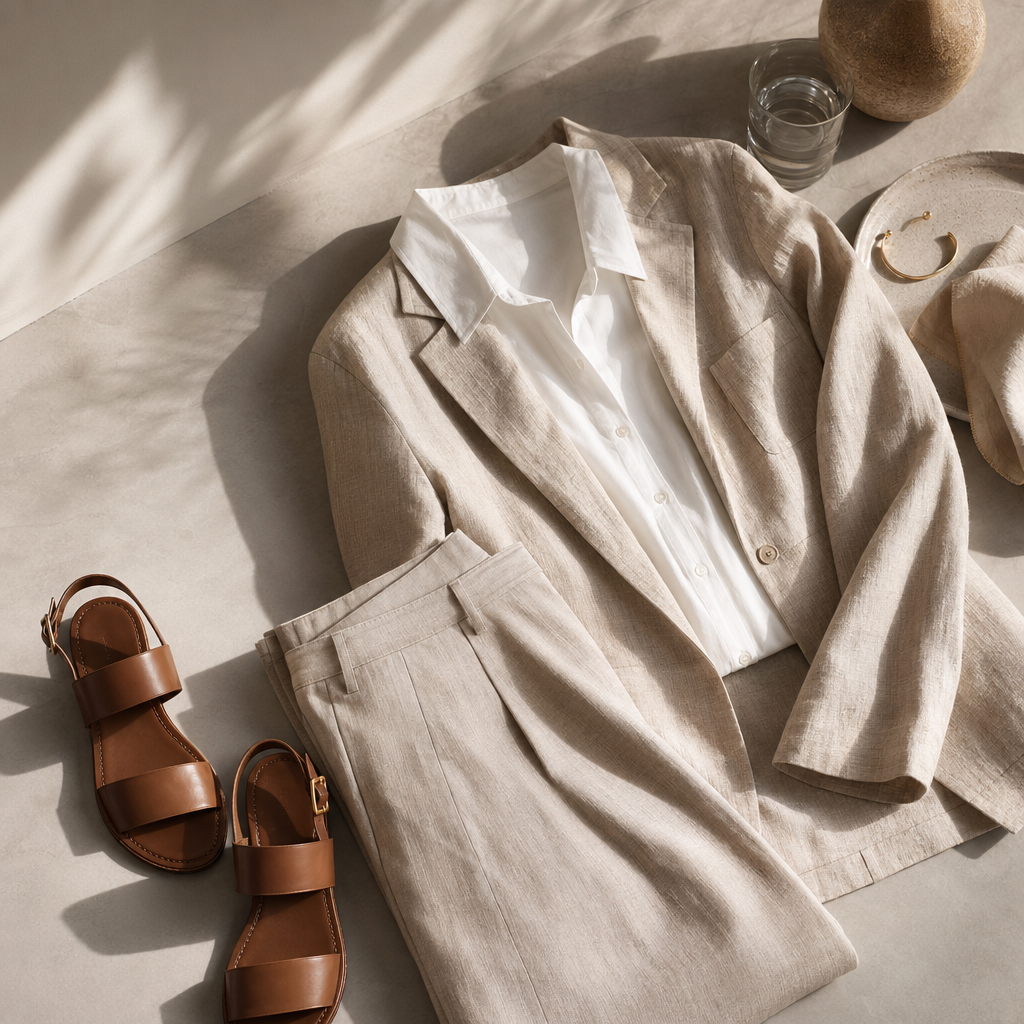
A dependable warm-weather workwear formula is simpler than it looks: a poplin shirt, wide linen-blend trousers and leather sandals, with a light layer nearby for air-conditioned rooms. Change the shirt colour, switch the trouser tone, adjust the sandal shape, and the combination can carry several days without appearing repetitive. That is the quiet strength of this wardrobe. It does not rely on novelty or exposure; it relies on fabrics that breathe, cuts that let you move, and enough polish to hold up from the morning commute to the last meeting.