Start with the outfit you actually repeat
A useful accessory capsule begins with observation rather than aspiration. Pull out the clothes you wear most in an ordinary fortnight: the wool coat, the straight jeans, the navy jumper, the white shirt, the black dress, the wide-leg trousers that need the right shoes and socks. Accessories earn their place when they solve a recurring problem in these outfits, not when they look charming in isolation.
For readers with smaller wardrobes, the aim is not to create more combinations for the sake of it. It is to make repeat wear feel deliberate. A black jumper worn twice in one week can read differently with a narrow leather belt on Monday, a silk scarf tucked at the neck on Thursday, and small gold or silver studs on Sunday. These are modest shifts, but they change proportion, texture, and mood without demanding extra storage or complicated styling.
The caveat is restraint. Capsule accessories work best when they are compatible with the clothes you already trust. If most of your wardrobe is cool-toned grey, navy, denim, and black, a warm tan belt may stand out more than expected. If you wear mostly cream, brown, olive, and indigo, high-shine silver might feel sharper than you want. Good accessory choices are not neutral in theory; they are neutral within your own wardrobe.
The leather belt test
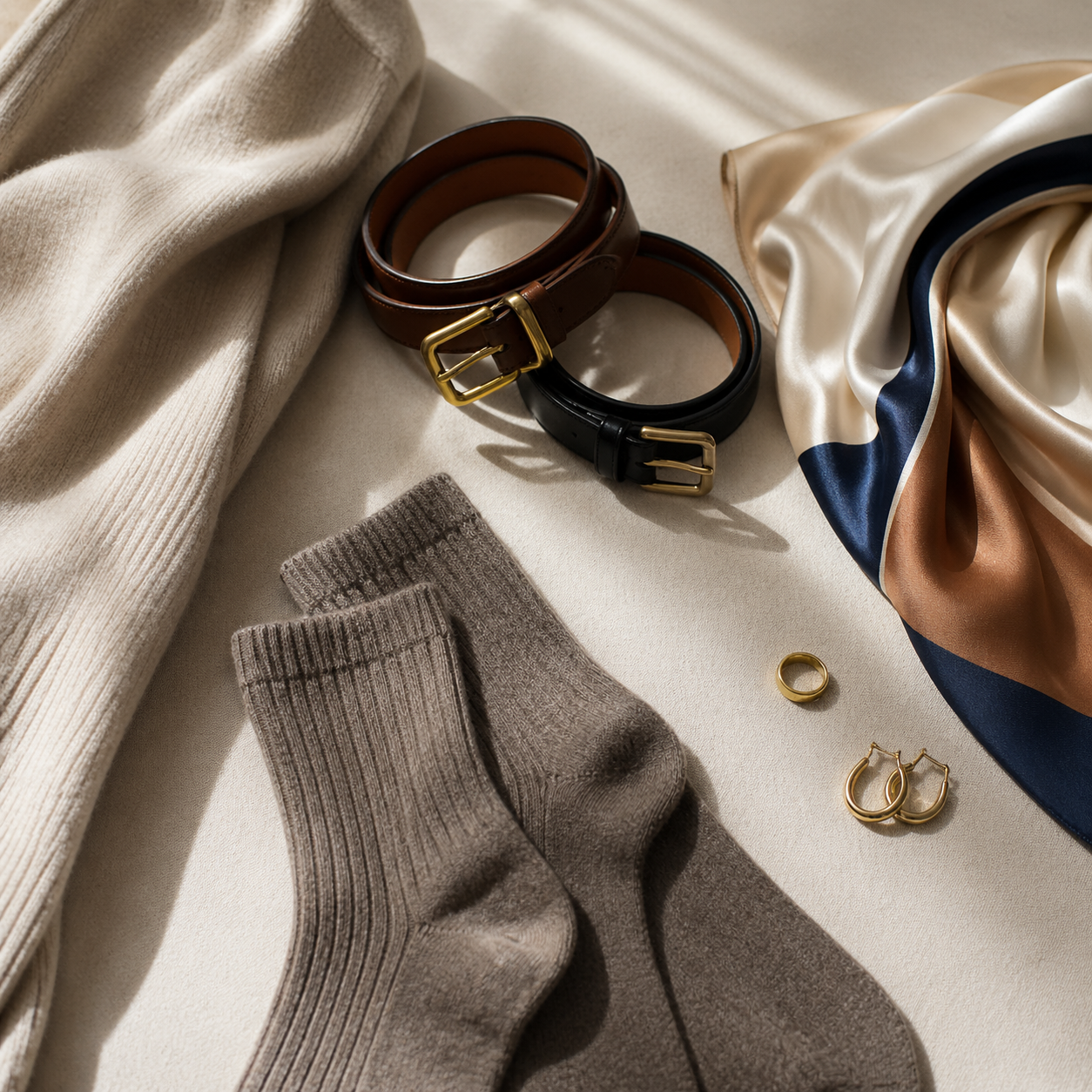
A leather belt is one of the quickest ways to make an outfit look fitted without altering the clothes. It can define a loose dress, sharpen a tucked shirt, or give structure to trousers that sit slightly lower than intended. The most useful widths tend to sit between very narrow and very wide: slim enough for belt loops, substantial enough to show under knitwear. A plain buckle is often more versatile than a decorative one, particularly if you dress for offices, travel, or mixed settings where too much hardware can feel distracting.
Look closely at leather quality and behaviour. Full-grain or well-finished leather will soften with wear but should not feel papery or crack at the punched holes after a few outings. The edge paint should be neat, and the buckle should sit flat rather than pulling away from the body. If you often wear high-waisted trousers, check that the belt does not dig into the ribs when seated. If you wear denim, make sure the belt fills the loops enough to avoid sliding around.
Care is simple but easily ignored. Let a damp belt dry naturally away from radiators, especially in wet climates where coats and umbrellas do not always protect the waist. Store belts rolled loosely or hung from the buckle, not folded sharply. Black, dark brown, and deep oxblood are the most forgiving colours for frequent wear; tan can be beautiful but shows water marks and denim transfer more readily. The right belt should disappear into your routine, then quietly improve half the outfits in it.
Silk scarves without fuss
The silk scarf has a reputation for being either very polished or oddly theatrical, but it can be practical in a modern capsule wardrobe when the scale and pattern are right. A small square works well at the neck, tied close under a crew-neck jumper or open shirt. A larger square can be folded into a band and worn with a coat, tied to a bag handle, or used to protect hair from wind on a coastal walk or a cold platform. In spring and autumn, silk gives a surprising layer of warmth without the bulk of wool.
Pattern deserves careful judgement. A scarf with two or three colours drawn from your wardrobe will work harder than a busy print full of shades you rarely wear. Cream with navy, charcoal with burgundy, olive with soft brown, or black with a muted blue can be easier to repeat than a bright, high-contrast design. Matte silk twill often feels less precious than glossy satin and sits better against knitwear, cotton shirting, and wool coats.
Maintenance matters because scarves live close to skin, perfume, sunscreen, and make-up. Air them after wear and avoid knotting them tightly while damp. Many silk scarves need gentle hand washing or careful cleaning according to the care label; if that feels unrealistic, choose darker grounds and prints that disguise light marks. The best scarf for everyday use is not the most dramatic one. It is the one you can tie without a mirror and wear with a jumper you have owned for years.
Wool socks change the line
Socks are often treated as an afterthought, yet they can make or break the line of an outfit, especially with cropped trousers, loafers, ankle boots, and trainers. Wool socks are particularly useful in the UK, northern Europe, Canada, and cooler parts of Australia because they manage temperature better than many cotton pairs. A fine merino blend can feel warm without bulk, while a thicker ribbed sock can make sturdy shoes more comfortable in winter.
The key is proportion. With loafers and straight trousers, a fine ribbed sock in charcoal, navy, chocolate, or cream can bridge the gap between hem and shoe. With chunky boots, a heavier wool sock can peek above the ankle and make the footwear look intentional rather than merely practical. Avoid socks that are so thick they tighten the shoe; compressed toes are not stylish, and they will make you abandon the outfit by lunchtime.
Good wool socks need sensible care if they are to survive repeat wear. Let them rest between wears, wash on a cool gentle cycle or by hand if instructed, and dry flat rather than over a hot radiator. Reinforced heels and toes are worth seeking out for daily use. If you walk a lot, consider darker colours for the soles and lighter colours only where they will not be punished by wet pavements, bike commutes, or muddy school runs. A drawer of three or four well-chosen wool pairs can make winter dressing feel noticeably more finished.
Simple jewellery, worn well
Simple jewellery is not about being plain. It is about choosing scale, finish, and placement with enough care that pieces can be worn often without competing with clothes. Small hoops, studs, a fine chain, a signet-style ring, or a narrow cuff can bring light to the face and hands, particularly when the rest of the outfit is built from wool, denim, cotton, or dark tailoring. The most useful pieces are comfortable enough for a full day and secure enough not to require constant checking.
Metal tone is personal, but consistency helps a small wardrobe. If you wear warm browns, camel, cream, rust, and olive, yellow-toned metals may feel harmonious. If your clothes lean towards black, grey, white, navy, and icy blue, silver-toned metals may sit more quietly. Mixing metals can look relaxed, but it works best when it appears intentional: for example, one dominant tone with a small contrast rather than equal amounts of everything.
Care should be part of the decision. Remove jewellery before swimming, heavy cleaning, or applying products that can dull finishes. Store pieces separately so chains do not knot and softer metals do not scratch. If you are sensitive to certain metals, check composition carefully before buying and avoid anything that you cannot comfortably wear against skin. Capsule accessories are successful when they reduce effort. A small set of jewellery that you reach for without thought will do more for your wardrobe than a crowded box of pieces that only suit rare occasions.