Online Fit Risk
Online Fit Risk is a online sizing guide for readers weighing measurements, model styling, size charts, and return strategy. The slow-shopping framework note explains what to check before buying, who should skip it, and where the purchase can become more work than it first appears.
The modern convenience of online shopping is heavily subsidized by the friction of poor fit. We have grown accustomed to treating our hallways as makeshift fitting rooms, ordering garments with the blind hope that a standardized 'Medium' will somehow map onto the complex, asymmetrical reality of the human body. This habit of speculative purchasing-often resulting in the practice of 'bracketing,' where multiple sizes of the same item are bought with the explicit intention of returning the rejects-exacts a heavy toll. Beyond the immediate frustration of a waistband that pinches or a shoulder seam that binds, sizing gambles introduce hidden financial costs, significant environmental waste, and the mental burden of managing reverse logistics. Navigating the digital rack requires a shift from passive consumption to active auditing. By understanding how specific materials behave over time, interpreting size charts through the lens of flat measurements rather than body dimensions, and reading customer reviews with the skepticism of a forensic accountant, you can drastically reduce your return rate. This is the essence of slower, more intentional buying: replacing the temporary dopamine hit of a dispatched order with the lasting satisfaction of a garment that actually fits your life.
The Illusion of Standard Sizing and Material Behavior
The concept of standard sizing is a persistent retail myth. A size '10' or 'Large' is not a metric unit of measurement; it is a marketing construct that fluctuates wildly between brands, decades, and even different production runs of the same garment. Vanity sizing has further distorted these numbers, gradually shifting dimensions upward to flatter the consumer's ego while rendering the tag entirely useless as a reliable indicator of fit. Relying on a letter or number to dictate your purchases guarantees a high failure rate. Instead, the focus must shift to the physical realities of the garment itself, beginning with how the chosen material dictates the final silhouette. The exact same numerical dimensions will yield an entirely different fit in a rigid cotton canvas compared to a fluid silk crepe.
Material behavior is the invisible variable in every size chart. A tightly woven, 100% cotton poplin shirt lacks mechanical stretch; it requires generous 'ease'-the deliberate space between the fabric and your skin-to accommodate the routine movements of reaching, sitting, and bending. If you buy rigid fabrics too close to your exact body measurements, the garment will pull at the seams and restrict your mobility. Conversely, fabrics cut on the bias, such as slip dresses or certain skirts, will naturally elongate and narrow as they drape over the body, meaning they often require a closer fit to hang correctly. Elastane blends offer a margin of error for sizing, stretching to accommodate minor discrepancies, but this convenience comes with a severe maintenance burden. High-stretch fabrics are prone to bagging out at the knees and elbows over a long day, and the elastic fibers degrade rapidly with frequent washing, shortening the garment's lifespan.
Understanding how a fabric interacts with your skin and body heat over time is crucial for long-term use. Linen, for instance, is notorious for relaxing; a pair of linen trousers that feel perfectly tailored at 8:00 AM may feel a half-size too large by mid-afternoon. Heavy wool coats require a different sizing strategy altogether, as their fit must account for the friction and bulk of winter layers worn underneath. When evaluating an online purchase, you are not just buying a set of measurements; you are buying the physical properties of the textile. Anticipating how the material will stretch, drape, or shrink after its first cold wash allows you to make a highly informed sizing decision, bypassing the generic recommendations of the retailer.
Decoding Size Charts and the Flat-Measure Routine
Most brand size charts are fundamentally flawed because they provide body measurements rather than garment measurements. A chart that dictates a 'Medium' fits a 36-inch chest offers no insight into how the garment will actually sit on your frame. Is it a slim-cut 38 inches, offering a tailored look? Or is it an oversized 44 inches, designed to drape generously? Without knowing the designer's intended ease, body measurements leave you guessing. The antidote to this ambiguity is the routine of flat measuring. This requires taking a tailor's tape measure to the best-fitting garments already hanging in your closet, establishing a personalized baseline for what actually works for your body.
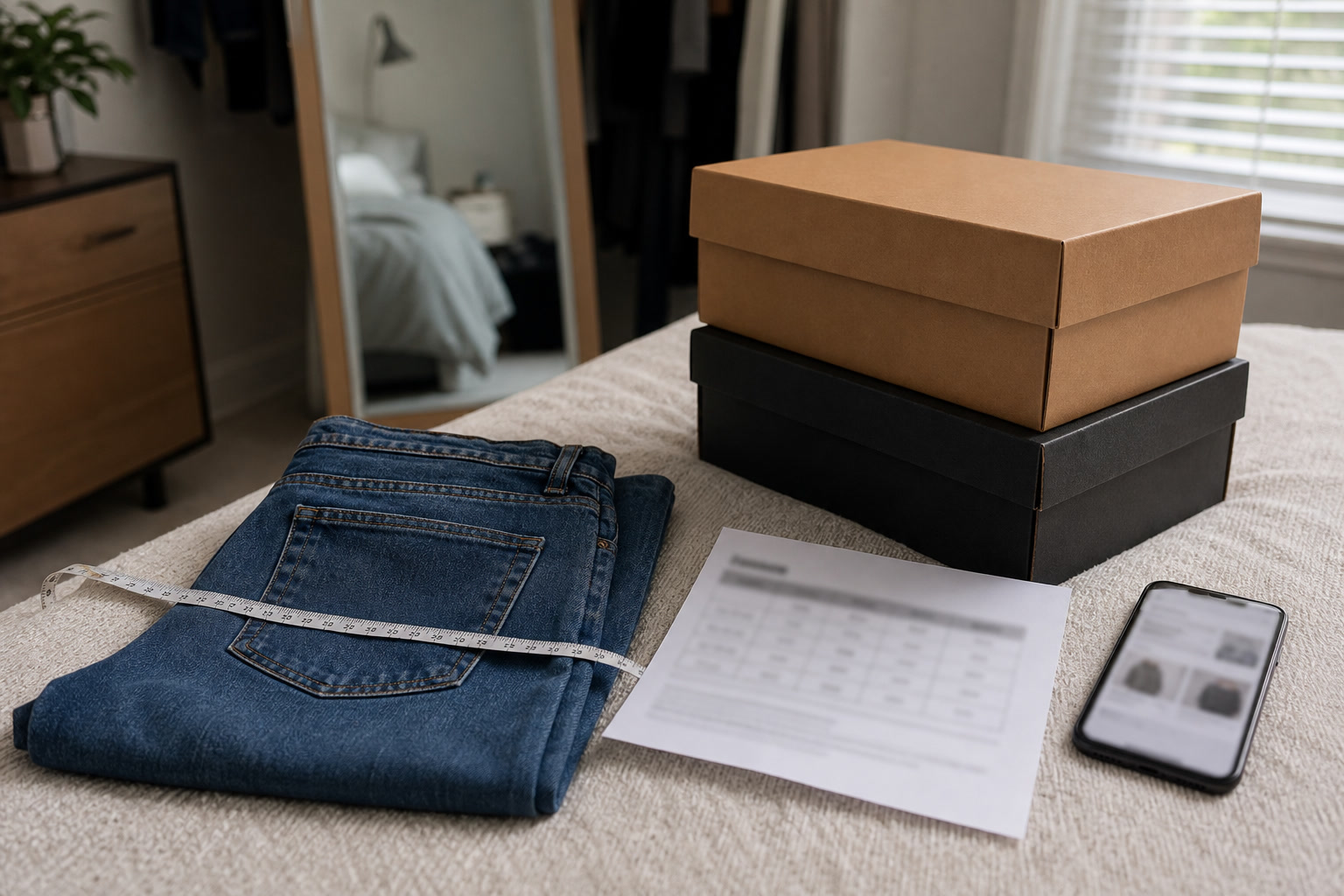
To build this reference guide, select garments that represent your ideal fit across different categories: a tailored blazer, a relaxed t-shirt, a pair of rigid denim jeans, and a fluid dress. Lay each item completely flat on a table and measure the critical points. For tops, measure pit-to-pit (chest), shoulder seam to shoulder seam, and center back length. For trousers, measure the waist aligned flat, the front rise from the crotch seam to the top of the waistband, the thigh width, and the inseam. The rise is particularly critical; a 30-inch waist on a high-rise trouser sits at an entirely different part of your torso than a 30-inch waist on a mid-rise pair. Document these numbers meticulously.
Keep this data stored in a dedicated note on your phone or computer. This transforms online shopping from a guessing game into a precise comparative exercise. When a brand provides exact garment measurements-a hallmark of transparent, slow-fashion labels-you can instantly cross-reference their numbers against your flat-measure archive. If a brand only provides body measurements, email their customer service team to request the flat measurements for your specific size. If they cannot or will not provide them, treat that opacity as a significant risk factor. Building and utilizing this personal measurement database is a low-effort, high-reward routine that virtually eliminates the shock of unboxing a garment that is fundamentally the wrong shape.
Reading Reviews Like a Forensic Auditor
Customer reviews are a chaotic mix of subjective opinions, shipping complaints, and incentivized praise. Navigating this section requires a ruthless filtering process. Ignore any review that simply states 'fits perfectly,' 'love the color,' or 'true to size.' These offer zero actionable data. 'True to size' is a meaningless phrase when standard sizing does not exist. Instead, you must read reviews like an auditor, scanning for specific, structural friction points. Look for comments that detail how the garment interacts with the body in motion: 'the armholes are cut too high and chafe,' 'the fabric pulls tightly across the shoulders when reaching forward,' or 'the waistband gaps at the back when sitting.'
Contextualizing the reviewer is just as important as the review itself. A complaint from a 5'10" customer that a midi dress 'fits awkwardly like a tunic' is incredibly valuable data if you are 5'4", as it suggests the hemline will likely hit you at the perfect mid-calf length. Seek out reviews from customers who share your specific height, weight, and general body shape. Pay close attention to mentions of laundering behavior and maintenance. A review noting that a viscose blouse shrank a full size despite being washed on a delicate cold cycle is a massive red flag, indicating poor fabric preshrinking at the factory level. This type of feedback helps you avoid garments that look great out of the box but fail after a single wash.
Be highly skeptical of aggregate star ratings, which are easily manipulated by brands offering discounts in exchange for five-star feedback. To find the truth about a garment's fit and quality, sort the reviews by 'Newest' to catch recent changes in manufacturing or fabric sourcing, and then sort by 'Lowest Rating.' The one- and two-star reviews are where the structural flaws of a garment are exposed. If multiple low-rated reviews complain about the exact same issue-such as a zipper that constantly snags or a seam that twists after washing-you can confidently assume it is a systemic manufacturing defect rather than an isolated incident. Use reviews to build a risk profile for the garment before you commit your money.
Alternatives and Long-Term Wardrobe Strategy
Breaking the cycle of speculative sizing requires shifting from a 'buy to try' mentality to a strategy of calculated acquisition. The most effective alternative to returning ill-fitting clothes is embracing the services of a local tailor. Off-the-rack clothing is cut to fit a mathematical average, not your specific body. If your measurements fall between sizes, or if you have proportions that deviate from the industry standard-such as broad shoulders and a narrow waist-always buy the size that accommodates your widest measurement. It is relatively inexpensive for a tailor to take in a waist, dart a blouse, or hem a sleeve, but it is nearly impossible to add fabric that isn't there. Factoring a $30 tailoring fee into the initial purchase price guarantees a bespoke fit and entirely eliminates the need for returns.
Another critical strategy is migrating your purchasing power toward brands that prioritize transparency. Seek out slow-fashion labels that publish comprehensive garment measurements for every single size, detail the exact fabric composition, and provide notes on the model's height and the size they are wearing. Brands that invest in this level of detail typically experience drastically lower return rates and foster long-term customer loyalty. When a brand respects your time by providing the data necessary to make an informed decision, they are signaling a commitment to quality over sheer volume.
Ultimately, mastering online sizing is about slowing down the pace of your consumption. A wardrobe built for long-term use is not assembled through late-night impulse buys and frantic returns. It is curated slowly, piece by piece, relying on a deep understanding of your own measurements, a critical eye for material behavior, and a willingness to invest in post-purchase tailoring. When you treat the digital checkout not as a dressing room, but as the final step in a rigorous selection process, you reclaim your time, protect your finances, and build a closet composed entirely of garments that fit flawlessly and endure beautifully.
Pre-purchase checklist
- Compare the brand's exact garment measurements against a similar, well-fitting item laid flat from your own closet, rather than relying solely on body measurements.
- Verify the fabric composition to anticipate mechanical stretch, drape, and potential post-wash shrinkage before finalizing your size selection.
- Filter customer reviews specifically for your height, weight, and body shape, aggressively ignoring generic five-star praise.
- Check the retailer's exact return policy for hidden restocking fees, return shipping deductions, and the specific timeframe for unworn items.
- Factor the cost and time of potential local tailoring into the purchase price if your measurements fall between two standard sizes.
Who should skip this
You should entirely skip buying fitted or highly structured garments online if you do not know your exact flat measurements and are unwilling to utilize a local tailor. Items like structured blazers, formal trousers, and rigid denim require millimeter precision to drape correctly, and the margin for error is virtually nonexistent. Furthermore, if the logistical chore of repacking boxes, printing shipping labels, and tracking refunds causes you significant mental fatigue, the online sizing gamble is not worth the stress. For consumers who experience 'return paralysis'-frequently missing return windows and absorbing the cost of unworn clothes-brick-and-mortar stores remain the only viable option, as the physical dressing room acts as an immediate, foolproof filter against bad fits.
Affiliate transparency
FikaLooks maintains strict editorial independence. We do not accept payment for brand placements, nor do we alter our sizing advice to favor specific retailers. If you purchase through certain links in our features, we may earn a small commission. This revenue directly funds our independent research, fabric analysis, and ad-free reading experience.
FAQ
Why do my body measurements match the size chart perfectly, but the garment still fits poorly?
Most standard size charts list body measurements, not the actual dimensions of the garment. They fail to account for 'ease'-the intentional extra fabric a designer includes for movement, layering, or a specific silhouette. A size chart cannot tell you if a shirt is cut for a slim, tailored fit or a boxy, oversized drape. Always request the exact flat measurements of the garment from customer service to understand how it will actually sit on your frame.
How can I tell from a product page if a fabric will stretch out during the day?
Look closely at the material composition. High percentages of elastane, spandex, or loosely knitted cotton provide initial comfort but are highly prone to bagging out at high-friction areas like the knees or elbows as the day progresses. Loosely woven linens also relax significantly with body heat. Conversely, tightly woven poplin, raw denim, and heavy wools will remain rigid and hold their structural shape, requiring you to ensure adequate ease when selecting a size.
Is 'bracketing' (buying multiple sizes to return the rejects) really that harmful?
Yes. Beyond tying up your personal finances and adding logistical chores to your week, bracketing has a massive environmental footprint. The reverse supply chain is incredibly expensive for retailers. Often, the cost of inspecting, steaming, repacking, and restocking a returned item exceeds its manufacturing cost. Consequently, millions of tons of perfectly good, returned clothing are routed directly to landfills or incinerators every year.
How do I handle sizing when buying from international brands with different size scales?
Ignore the localized size translations entirely (e.g., assuming a 'US 6' perfectly translates to a 'FR 38' or 'IT 42'). These conversions are notoriously inaccurate. Instead, rely exclusively on the raw centimeter or inch measurements provided. Keep in mind that European cuts often run narrower in the shoulders and hips compared to American sizing, so cross-reference the brand's numerical data against your own flat-measured garments carefully.