Knitwear Care Routine
Knitwear Care Routine is a care guide for readers weighing pilling, drying shape, storage, and gentle washing tools. The wardrobe decision note explains what to check before buying, who should skip it, and where the purchase can become more work than it first appears.
Knitwear demands a relationship. You do not simply buy a wool sweater; you adopt its maintenance schedule. The difference between a garment that lasts a decade and one that looks ragged by February lies entirely in how you handle friction, moisture, and gravity. This guide strips away the romanticized marketing of low-fuss cozy layers to examine the mechanical reality of knitted fibers. We will cover the tactile indicators you must check before removing the tags, the physics of why high-end cashmere pills, the exact protocol for water extraction without warping the gauge, and the storage architecture required to defend against both moths and structural distortion. Understanding these elements transforms knitwear from a disposable seasonal purchase into a permanent wardrobe fixture.
Pre-Purchase Triage and Material Mechanics
The garment label is a legal requirement, not a performance guarantee. When evaluating a new sweater, the fiber composition only tells half the story. A garment labeled as pure cashmere can still deteriorate rapidly if the manufacturer utilized short-staple fibers. These shorter hairs require tighter spinning for durability, but they are frequently spun loosely to create an immediate, deceptive softness on the retail floor. This artificial loft, often achieved by over-washing the yarns at the factory, means the fibers are already exhausted before you wear them. To test for this, pinch a small section of the knit between your thumb and forefinger and gently rub them together. If the fibers immediately shed or form a microscopic fuzz cloud, return the garment. It will pill aggressively within the first three wears.
Tension and gauge dictate structural integrity. A high-gauge knit, characterized by finer, tighter stitches, inherently resists friction better than a low-gauge, chunky knit. When inspecting a sweater, stretch a small section of the hem or cuff. It should snap back to its original dimensions immediately. If the yarn feels sluggish or remains slightly distorted, the garment lacks the inherent elasticity necessary to survive daily movement. This sluggishness is common in poor-quality cotton knits and heavily synthetic blends, which rely on elastane rather than the natural crimp of animal hair for recovery. A sweater that cannot recover its shape on the hanger will certainly bag out at the elbows and hem after a day of wear.
Consider the tactile reality against bare skin and the return risks associated with online purchases. Wool sensitivity is not a myth; the micron count of the fiber determines whether it bends against your skin or pricks it. Merino wool under twenty microns generally feels smooth, while anything above twenty-five microns will trigger an itch response in sensitive individuals. When buying heavy knits online, pay attention to the garment weight. A proper fisherman's rib sweater can weigh over a kilogram. This weight affects how the neckline sits and how the shoulders drape. If the retailer does not list the garment weight or provide close-up macro shots of the stitch definition, you are taking a significant gamble on the fit and drape.
Blends are not inherently evil, but their purpose must be structural, not financial. A blend of five percent cashmere and ninety-five percent viscose is a cynical margin-builder that will pill immediately and offer zero thermal regulation. Conversely, a blend of seventy percent merino, twenty percent silk, and ten percent cashmere utilizes silk for tensile strength and drape, merino for structure and breathability, and cashmere for surface softness. When evaluating a blend, ask yourself what mechanical property each fiber brings to the garment. If a synthetic fiber exceeds twenty percent of the composition, the sweater will likely trap sweat, retain odor, and develop hard, unyielding pills that are difficult to remove without tearing the base fabric.
The Inevitability of Pilling and Surface Maintenance
Pilling is a mechanical certainty, not necessarily a sign of poor quality. It occurs when loose fibers migrate to the surface of the fabric, tangle together due to friction, and form small balls. Even the most expensive, long-staple Scottish cashmere will pill in high-friction zones during its initial wears. The critical distinction lies in how the pills behave. On high-quality natural fibers, pills are soft, loosely attached, and easily removed. On synthetic blends, the high tensile strength of nylon or polyester anchors the pill to the fabric surface, creating hard, stubborn knots that require aggressive shaving, which eventually thins out the garment and compromises its structural integrity.
Identifying your personal friction zones is the first step in managing surface wear. Crossbody bags, the interior lining of a stiff winter coat, seatbelts, and even the edge of a wooden desk all act as abrasive surfaces. If you carry a canvas tote with a rough weave, the side of your sweater resting against it will deteriorate rapidly. Before blaming the manufacturer for premature wear, audit your daily physical environment. If your lifestyle necessitates heavy backpacks or rigid outerwear, delicate loose-knit cashmere is structurally incompatible with your routine, and you should pivot toward tightly woven worsted wools or dense cotton knits that can withstand the abrasion.
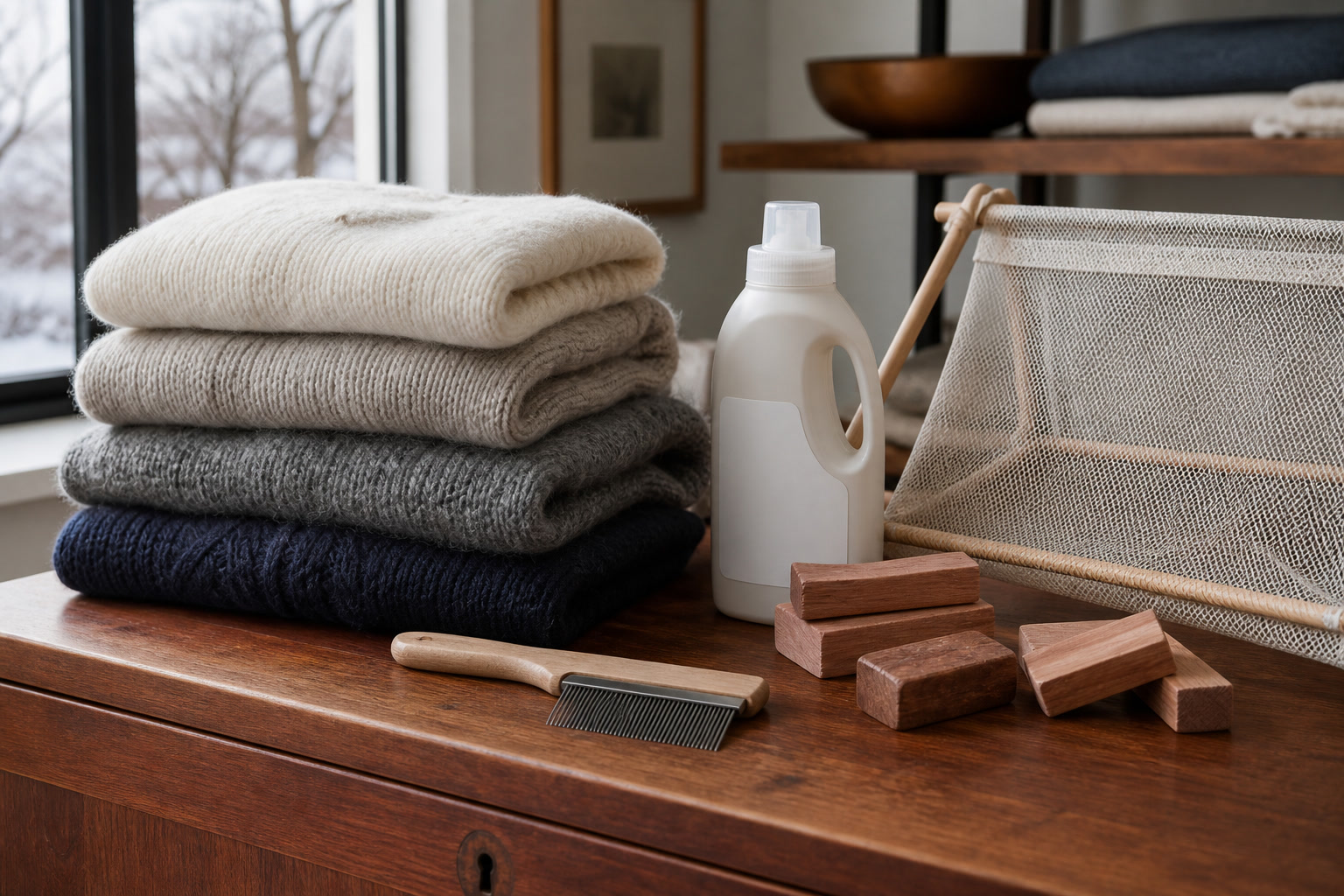
The tools you use for depilling dictate the lifespan of the sweater. Never pull pills off by hand; this extracts the anchored end of the fiber from the yarn base, creating a weak spot and pulling up new fibers to replace the one you just removed, thereby accelerating the pilling cycle. For fine-gauge knits, a cedar sweater comb with a brass mesh edge is the safest tool, gently catching and snapping the tangled fibers without cutting into the structural yarn. For heavier, chunkier knits, a pumice sweater stone provides the right amount of broad-surface friction to detach pills without snagging the thicker loops.
Battery-operated fabric shavers are highly effective but carry significant risk. They should only be used on a completely flat, hard surface, never while wearing the garment or on a soft bed. A single hidden crease or a slight shift in tension can cause the rotary blades to catch the base fabric, instantly creating a hole that requires professional reweaving. When using a shaver, apply zero downward pressure; let the metal guard glide over the surface like a hovercraft. Reserve electric shavers for dense, tightly knit garments and use manual combs for anything with a loose or fluffy halo to prevent accidental shearing of the structural fibers.
Aqueous Cleaning and the Physics of Drying
Dry cleaning is a solvent-based process designed to remove oil, not water-soluble dirt like sweat. Subjecting natural animal fibers to harsh perchloroethylene strips them of their natural lanolin, leaving the yarn brittle, dull, and prone to snapping. Unless the garment has complex structural elements like leather trims or heavy tailoring, hand washing is the superior method for longevity. The goal is to clean the fibers without agitating them into felt. Fill a basin with tepid water. Never use hot water, which shrinks wool, and never use ice-cold water, which shocks it. Use a specialized wool wash containing lanolin to replenish the fibers' natural oils and maintain their suppleness.
The mechanics of the wash require patience, not force. Submerge the sweater and gently press the suds through the fabric. Do not wring, twist, or scrub the fibers against each other. Friction combined with moisture and heat is the exact recipe for felting, a process where the microscopic scales on the wool fibers lock together permanently, shrinking the garment into a dense, unwearable mat. Let the sweater soak for fifteen minutes to allow the surfactant to lift the body oils. Drain the basin, support the entire weight of the wet sweater from underneath, and refill with clean, tepid water for rinsing. Repeat the pressing motion until the water runs clear.
Water extraction is the most dangerous phase of knitwear maintenance. A wet wool sweater can weigh three times its dry weight, and gravity is its absolute enemy. Never lift a wet knit by the shoulders or pull it from the basin by the sleeves. Scoop it up in a ball, pressing it against the side of the basin to expel the bulk of the water. Then, lay the garment flat on a clean, dry bath towel. Roll the towel up with the sweater inside, like a cylinder, and press down firmly along the length of the roll. The heavy terrycloth will absorb the excess moisture without subjecting the delicate yarns to any tensile stress.
Drying must occur horizontally and in the correct atmospheric conditions. Transfer the damp sweater to a mesh drying rack to allow air circulation from beneath. This is the moment to block the garment, gently nudging the seams, sleeves, and hem back to their original dimensions. Pay special attention to the neckline and the ribbed cuffs, patting them into shape so they dry flush and tight. Avoid direct sunlight, which degrades the protein bonds in wool and fades dyes, and keep the rack away from direct heat sources like radiators, which will bake the fibers, cause localized shrinkage, and render the yarn permanently stiff.
Structural Storage and Pest Defense
Gravity never stops working, and hanging a knit sweater is a guaranteed method for destroying its architecture. Standard hangers create permanent dimples in the shoulder lines and allow the weight of the torso and sleeves to stretch the garment vertically. Over a single season, a heavy wool sweater left on a hanger can lengthen by several inches, distorting the armholes and ruining the drape. All knitwear must be folded. If you lack drawer space and absolutely must use a closet rod, fold the sweater in half vertically, place the hook of the hanger at the armpit, and fold the sleeves and the body over the shoulders of the hanger to distribute the weight evenly.
The folding technique itself matters. Avoid stacking heavy, chunky knits on top of delicate, fine-gauge pieces, as the sheer weight will crush the loft out of the finer yarns. When folding, aim for a method that minimizes hard creases down the center front of the garment. If storing in deep drawers, consider a vertical folding method, which allows you to see all your garments without having to dig through a heavy stack. This reduces the friction and pulling that occurs when yanking a sweater from the bottom of a pile, protecting the surface fibers from unnecessary daily abrasion.
Moths do not eat wool; their larvae do, and they are exclusively attracted to the proteins found in animal fibers, specifically keratin, which is heavily concentrated in microscopic traces of human sweat, skin cells, and food spills. Storing a sweater that has been worn even once without washing it is an open invitation to an infestation. Before packing knits away for the summer, they must undergo a meticulous deep clean. Even a drop of clear soup or a faint trace of perfume left on the collar provides enough sustenance for larvae to decimate the garment during the warmer months.
Chemical mothballs containing naphthalene are toxic, leave a permanent acrid odor, and are largely unnecessary if proper hygiene and physical barriers are employed. Store clean, completely dry sweaters in breathable cotton canvas zip bags. Avoid airtight plastic bins, which trap residual moisture and promote mildew, especially in humid climates. Introduce natural deterrents like cedar blocks or dried lavender sachets, but understand that these only mask the scent of the wool from adult moths; they do not kill existing larvae. Sand cedar blocks lightly every season to release their volatile oils, and never let the wood rest directly against light-colored knits to prevent oil staining.
Lifecycle Expectations and Pragmatic Alternatives
Every knitted garment has a finite lifespan, dictated by the inherent fragility of spun yarn. Accepting this reality allows for more rational purchasing decisions. A gossamer-thin cashmere turtleneck is an exquisite luxury, but it is fundamentally a fragile object. It cannot be your daily workhorse if your commute involves crowded trains, heavy overcoats, and abrasive seating. Reserve delicate knits for low-impact environments. If a sweater begins to thin at the elbows or the cuffs lose their elasticity despite proper washing, it is entering the final phase of its lifecycle. Minor holes can be repaired via visible mending or professional reweaving, but structural exhaustion is irreversible.
For those whose daily routines demand durability over supreme softness, high-twist worsted wools offer a brilliant compromise. Because the fibers are combed to lie parallel and spun tightly, worsted knits present a smooth, dense surface that aggressively resists pilling and snagging. They lack the fluffy halo of woolen-spun yarns, but they drape beautifully and survive friction far better. Look for garments described as crepe knits or high-twist merino. They provide the thermal regulation of wool without the constant maintenance anxiety associated with softer, loftier yarns, making them ideal for office environments and frequent travel.
Boiled wool and felted knits represent another highly durable alternative. By intentionally subjecting the knitted fabric to heat and agitation during manufacturing, the fibers lock together, creating a dense, wind-resistant material that will never pill or unravel. Boiled wool jackets and heavy overshirts function as exceptional mid-layers. While they lack the fluid drape of a traditional sweater, their architectural rigidity and zero-maintenance surface make them ideal for high-friction daily wear. They offer the warmth of wool but behave mechanically more like a woven jacket, eliminating the fear of snags and structural warping.
Finally, consider the heavy cotton knit. While cotton lacks the warmth-to-weight ratio and moisture-wicking brilliance of wool, a densely knitted cotton sweater, such as a traditional Guernsey or a heavy shaker stitch, provides substantial weight and a completely itch-free experience. Cotton does not pill in the same manner as animal fibers, and it can withstand slightly more aggressive washing. However, cotton relies heavily on the tightness of its gauge to maintain its shape, as it lacks natural elasticity. When buying cotton knits, prioritize heavy, rigid constructions over loose, drapey designs, which will inevitably bag out at the elbows and hem over time.
Pre-purchase checklist
- Check the fiber composition for functional blending; reject items where synthetics exceed twenty percent unless used for specific structural reinforcement.
- Perform the pinch-and-rub test on the retail floor to identify artificially lofted, short-staple yarns that will pill immediately upon wear.
- Stretch the hem or cuff to evaluate the yarn's recovery and inherent elasticity; sluggish snap-back indicates a short lifespan and poor shape retention.
- Audit your daily friction points, including bags, coats, and desks, to ensure the garment's gauge and material are compatible with your physical routine.
- Verify you have the correct maintenance infrastructure at home before purchasing: a mesh drying rack, wool-specific detergent, and a manual sweater comb.
Who should skip this
Do not invest in high-end, pure animal fiber knitwear if you view clothing maintenance as an imposition rather than a ritual. If your laundry routine strictly consists of machine washing on normal cycles and tumble drying, purchasing a fine merino or cashmere sweater is a waste of capital; it will be ruined within a month. Similarly, if your profession or daily commute involves constant physical friction-carrying rough canvas bags, wearing rigid tactical or utility outerwear, or leaning against abrasive surfaces-delicate knits will disintegrate rapidly. In these scenarios, redirect your budget toward dense cotton sweatshirts, boiled wool overshirts, or tightly woven flannel, which offer warmth without the fragility or the demanding upkeep.
Affiliate transparency
FikaLooks maintains strict editorial independence. We do not accept payment for garment reviews or brand placements. If you purchase a sweater comb, wool wash, or storage solution through the links in this guide, we may earn a small commission. This funds our research and allows us to continue producing comprehensive, ad-free maintenance manuals.
FAQ
Can I use regular laundry detergent or fabric softener on wool sweaters?
Absolutely not. Standard laundry detergents contain biological enzymes specifically designed to break down protein-based stains like food and blood. Because wool and cashmere are made of animal hair, they are entirely protein-based. These enzymes will literally digest the fibers of your sweater, causing microscopic pitting that leads to brittleness and holes. Fabric softeners coat the yarns in a silicone residue that destroys wool's natural ability to regulate temperature and wick moisture, leaving the garment feeling slimy and trapping odors. Always use a pH-neutral wash specifically formulated for wool.
I accidentally shrank my wool sweater in the wash. Can it be un-shrunk?
True felting, where the microscopic scales of the wool fibers have locked together due to heat and agitation, is irreversible. The fabric becomes permanently dense and matted. However, if the sweater has merely contracted due to tension tightening, you can attempt to relax it. Soak the garment in tepid water mixed with a generous amount of hair conditioner for thirty minutes. The conditioner lubricates the fibers. Gently stretch the sweater back to its original dimensions while wet, pin it to a blocking board, and allow it to dry completely. This only works for minor shrinkage, not full felting.
How do I fix a pulled thread or snag without ruining the knit?
Never cut a snagged thread. Cutting it breaks the continuous loop of the knitted structure, which will immediately cause a run and create a hole. Instead, use a snag repair needle, which is a tiny needle with a textured end, or a very fine crochet hook. Insert the tool from the inside of the sweater directly behind the snag, catch the loose loop, and pull it through to the interior wrong side of the garment. Gently stretch the fabric in all directions to redistribute the tension in the yarn. Leave the loop hanging on the inside.
Is it safe to use the hand wash or wool cycle on my modern washing machine?
It is a calculated risk. While modern high-end machines have sophisticated wool cycles that minimize drum rotation and rely on gentle rocking, you are still surrendering control over water temperature fluctuations and spin velocity. A sudden influx of warm water or an overly aggressive spin cycle to extract moisture can cause irreversible felting or stretching. If the sweater is an irreplaceable vintage piece or a high-value cashmere investment, the basin method remains the only zero-risk option. Machine cycles are best reserved for sturdy, tightly spun everyday merino or heavy cotton knits.