Why grey-blue earns its place
A good grey blue wardrobe is not about collecting every pale blue item you see. The shade is valuable because it behaves like a neutral while still bringing colour to the face. Pure baby blue can feel too sweet against oatmeal knits and beige trousers; steel blue can read too corporate; navy can close an outfit down. Grey-blue lands in the middle, with enough mistiness to sit beside cream, ecru, mushroom, charcoal, and black.
The most useful versions have a little dust in them. Think washed chambray, faded Oxford cotton, blue-grey wool, brushed alpaca blends, and the cool cast of denim after years of laundering. If a shade looks bright under shop lighting, test it against your usual coat or knitwear before committing. Grey-blue should calm an outfit, not shout from it. In northern European winter light, Canadian snow glare, or the flat brightness of an Australian spring morning, the best tones keep their softness without turning icy.
This is why the colour works so well for repeat wear. It does not announce itself as a statement, so it can appear several times a week without feeling repetitive. A grey-blue shirt under a grey coat on Monday can become the same shirt open over a white vest in milder weather. A scarf in the same family can be worn with black leather gloves, a taupe trench, or a charcoal jumper without requiring the rest of the outfit to change.
Start with the shirt
The blue shirt is the simplest entry point, but the fabric matters. A crisp poplin in grey-blue looks clean under tailoring and is useful for office days, especially when white feels too stark against winter skin. Oxford cloth gives a more lived-in effect and holds up well to regular washing. Chambray is softer again, with a workwear note that suits black leather belts, loafers, boots, or a slightly worn jacket. For warm climates or humid summers, a linen-cotton blend will crease, but in this colour the creasing looks relaxed rather than careless.
Fit is where the shade either becomes modern or drifts into blandness. A shirt should have enough room at the shoulder and back to move under a coat, but not so much volume that it balloons beneath knitwear. If you wear it tucked, check that the hem is long enough to stay put when sitting on a train, cycling to work, or reaching for a bag. If you wear it untucked, the hem should finish around the upper hip rather than mid-thigh, unless you are deliberately using it as a tunic over narrow trousers.
Grey-blue also handles laundering better than deeper navy, which can fade unevenly at collars and cuffs. Wash shirts inside out on a cool cycle, use a modest spin, and avoid optical brighteners if you want to preserve the muted tone. Line-drying on a hanger reduces ironing, though a quick press at the placket and collar makes a large difference. The charm of this colour is softness, not neglect.
The winter balance
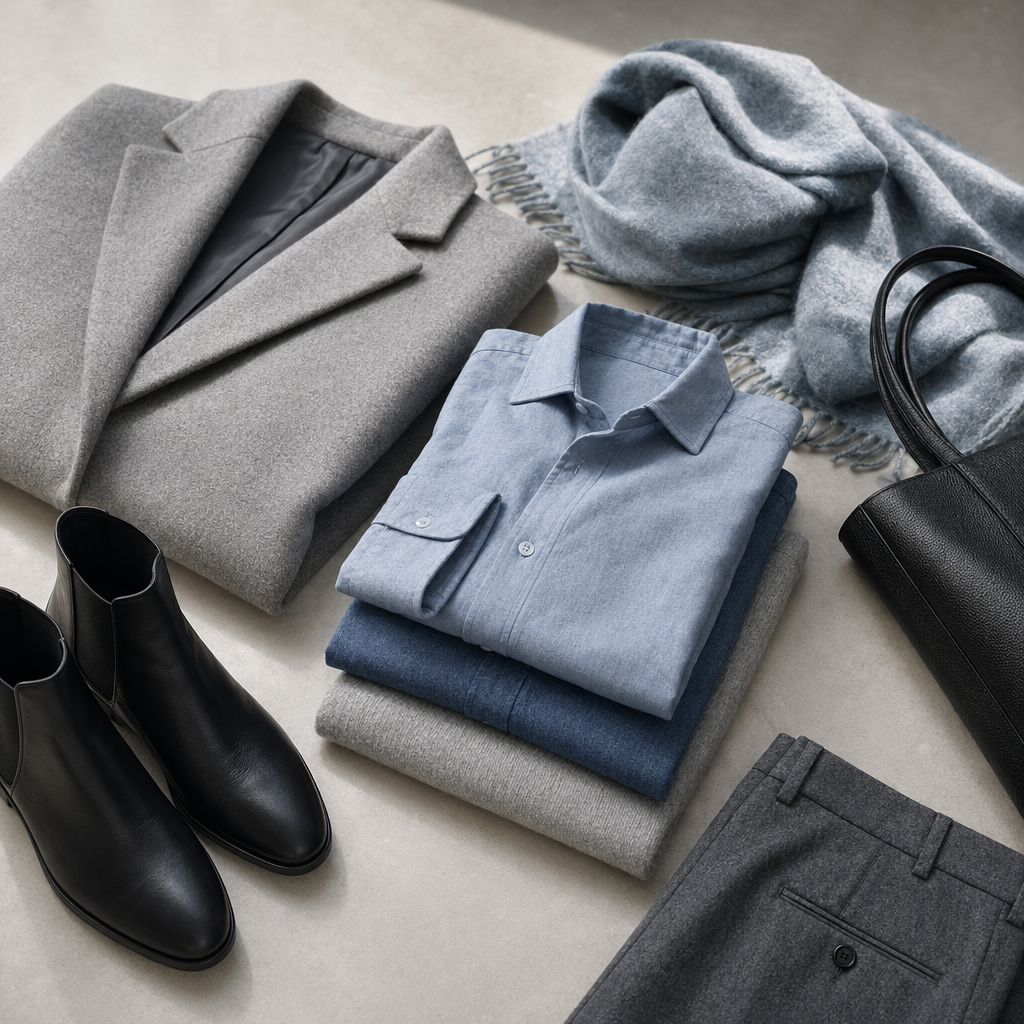
Grey coats and grey-blue accessories have a natural relationship, but contrast is important. If the coat is pale dove grey, choose a scarf with more blue in it so the outfit does not become foggy. If the coat is charcoal, a misty blue scarf will lift the face and break the dark column. Mid-grey wool coats can take either direction, though texture becomes the deciding factor: a brushed scarf against a smooth melton coat looks considered, while a flat scarf on flat cloth can feel thin.
Brushed scarves are particularly effective in this colour story because they bring warmth to a cool shade. Wool, alpaca, mohair blends, and brushed cashmere all catch light differently, making grey-blue appear less severe. The caveat is shedding and pilling. Long fibres may leave traces on black coats or black leather, especially during the first wears. A gentle shake outdoors, careful storage, and occasional use of a fabric comb will help. Avoid aggressive de-pilling on airy brushed fabrics; it can strip the surface and shorten the life of the piece.
Proportion should follow the coat. A long, double-faced coat can carry a generous scarf wrapped once with the ends left loose. A shorter pea coat or car coat usually looks better with a narrower scarf tucked close at the neck, especially in wet weather when dangling ends become impractical. In rain-prone cities, a brushed scarf is best saved for cold, dry days. On damp commutes, a tighter wool weave or compact rib will cope better and dry more predictably.
Black leather keeps it grounded
The reason grey-blue works so well with black leather is that the leather supplies definition. Without it, a light-neutral outfit can become overly gentle: ivory knit, stone trouser, grey-blue shirt, pale coat. Add a black belt, smooth boot, loafer, bag, or glove, and the whole look sharpens. The black does not need to dominate. A narrow belt at the waist or a pair of polished ankle boots is enough to give the colour story a clear edge.
Texture again matters. Smooth black leather makes grey-blue look cleaner and more urban. Pebbled leather is softer and easier with casual clothes. Suede, while beautiful, absorbs light and can make the outfit feel more muted, so it works best when there is crispness elsewhere: a pressed shirt, a structured coat, or a straight trouser with a clean hem. In wet climates, treated leather is often more practical than suede, particularly through British drizzle, Canadian slush, or sudden coastal rain in Australia.
Care is part of the look. Scuffed black leather beside a refined grey-blue shirt can be appealing if the scuffs feel honest and maintained, not dried out. Wipe boots after rain, let them dry away from direct heat, and use conditioner sparingly when the leather begins to look thirsty. Grey-blue is a soft colour; it shows when the supporting pieces are tired. The aim is not perfection, but upkeep.
How to wear it often
For daily dressing, grey-blue is strongest when repeated with restraint. A shirt and scarf in related tones can work together if they differ in texture or depth. A smooth blue shirt under a pale knit with a brushed blue-grey scarf feels layered rather than matched. Avoid pairing too many flat, similar shades near the face; it can wash out both the wearer and the clothes. If your wardrobe is built around light neutrals, use white or cream as a pause between grey-blue pieces.
One reliable formula is a grey-blue Oxford shirt, ecru knit, straight charcoal trousers, black leather loafers, and a grey coat. Another is a chambray shirt worn open over a white T-shirt, with stone trousers, a black belt, and a soft grey jacket for spring or early autumn. In colder weather, a blue-grey scarf over a dark jumper and grey coat gives colour without requiring a patterned accessory. These combinations suit repeat wear because each piece can move elsewhere in the wardrobe.
The main caveat is undertone. Some grey-blues lean green, which can look excellent with khaki and warm beige but less clear with cool greys. Others lean lavender, which can be pretty but harder to pair with black leather and taupe. View the colour in daylight if possible, not only under warm indoor bulbs. The best grey-blue for a quiet wardrobe should make your existing neutrals look intentional, not force you to buy around it. That is its real value: a soft colour that works hard without asking to be noticed first.